
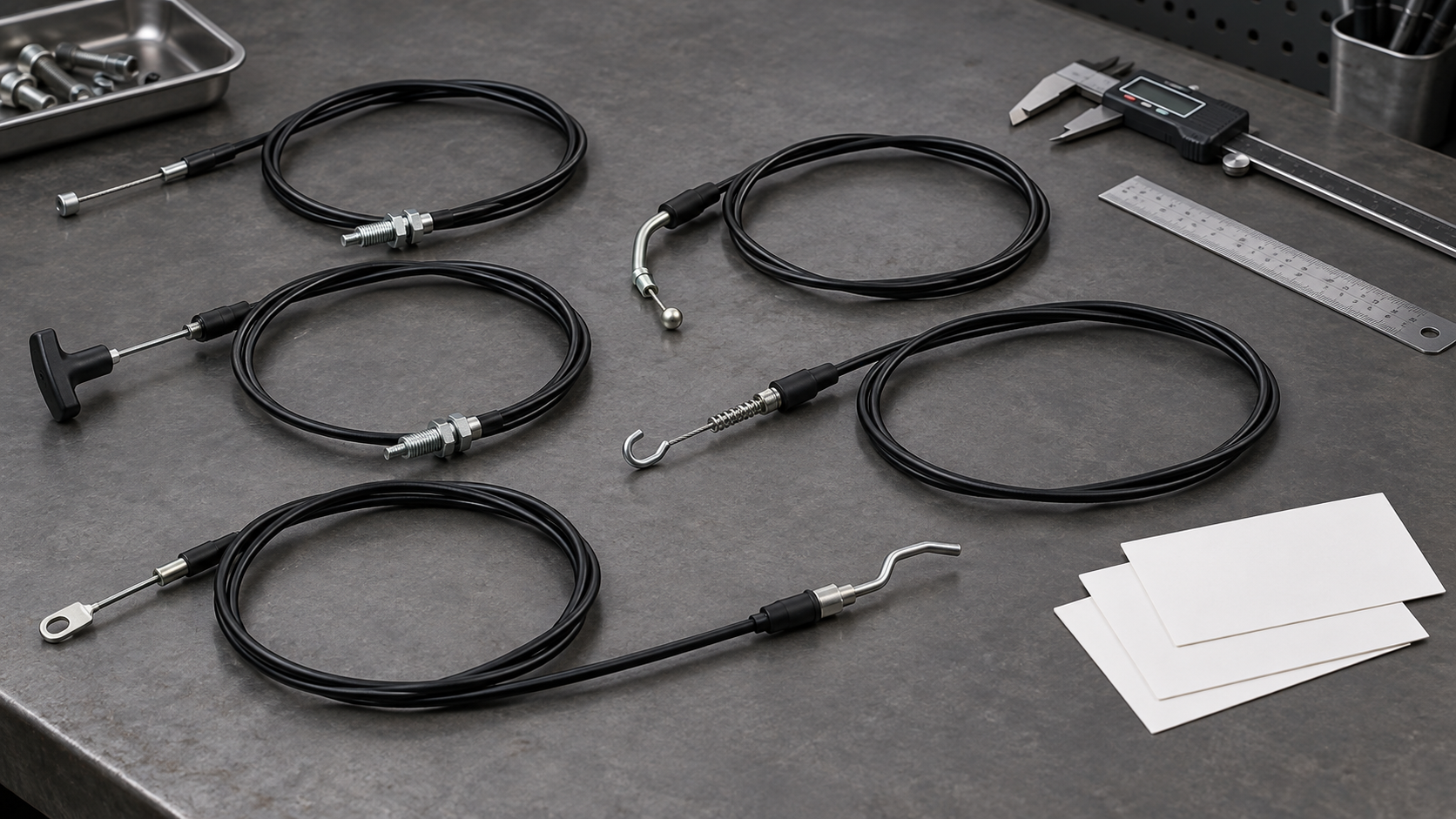
Cable sourcing pressure begins with incomplete fitment data
A buyer may receive a request that contains only a part number, a mower model, and a photo. That can be enough to start a search, but it is rarely enough to approve a cable for a catalog or purchase order. Two cables may look similar while differing in control function, end fitting, housing length, inner-wire length, usable travel, mounting points, or routing. A mismatch can leave the purchasing team with a low unit price and a high downstream correction cost.
For distributors, importers, wholesalers, aftermarket retailers, and repair networks, the goal is not merely to find a visually similar item. It is to build a traceable row of evidence that a supplier can review and the buyer can approve. This checklist explains how to structure inquiries for wholesale lawn mower cables without treating a photo or cross-reference as automatic proof of fitment.
Classify the cable by function before comparing dimensions
Start with what the cable controls. The function determines which interfaces and measurements deserve the most attention. Keep your own terminology consistent, and record the wording used in the original customer or branch request.
| Functional group | First buyer question | Details to verify next |
|---|---|---|
| Zone or operator-control cable | What control action starts or stops through this cable? | Handle connection, equipment-side connection, mounting points, routing, and travel |
| Deck engagement or clutch cable | What mechanism is being engaged or released? | End geometry, spring or bracket relationship, housing stops, travel, and deck context |
| Throttle cable | How does the control lever connect to the engine-side mechanism? | Lever interface, wire end, housing length, travel, routing, and application |
| Traction or drive-control cable | Which drive-control function does the cable operate? | Both interfaces, adjuster position, mounting, usable travel, and mower configuration |
This functional label is a screening tool, not a fitment conclusion. If the function is uncertain, mark the row for clarification instead of forcing it into the closest category.
Use a nine-part cable fitment checklist
1. Preserve every reference exactly as received
Keep the original part number, punctuation, prefix, suffix, and spacing in a source-reference field. Store any normalized search value separately. Add the buyer’s internal SKU and the source of the request. This keeps the original evidence intact when teams later compare supplier candidates or correct a mapping.
2. Record application context without guessing
Capture the equipment type, model, series, deck or drive configuration, and any other context the requester supplied. If a production range or variation is not documented, leave it open. A familiar model name does not justify adding an unverified compatibility statement.
3. Describe both end fittings
Identify the control-side and equipment-side ends independently. Use clear descriptions and labeled photos rather than vague terms such as “standard end.” Note hooks, bends, barrels, loops, springs, threaded sections, or other visible features only as they apply to the actual requested row. Orientation can matter, so show how each end sits relative to the housing.
4. Separate housing length from inner-wire length
A single value labeled “cable length” is ambiguous. Define whether the measurement covers the outer housing, exposed wire, end-to-end assembly, or another controlled span. Name the measurement points, state the unit, and avoid converting dimensions without retaining the original value.
5. Capture usable travel and resting position
Overall length alone does not explain how far the inner wire must move. Record the method used to measure travel, the start and end positions, and whether any adjuster was included in that state. For deck engagement cable fitment, an apparently close assembly can still be unsuitable if the control motion or resting relationship is different.
6. Document housing stops, clips, brackets, and adjusters
Show where the housing is retained and how the assembly mounts along its route. Record the position and type of clips, threaded adjusters, brackets, shoulders, or molded stops visible on the sample or reliable documentation. A correct end fitting does not compensate for an incompatible mounting interface.
7. Map the routing and bend context
Use a simple routing sketch or labeled equipment photos when available. Identify the control point, retention points, moving mechanism, and areas where the cable changes direction. Do not infer an acceptable bend or installation path from appearance alone; the buyer’s application review should determine what is suitable.
8. Tie photos and documents to one RFQ row
Give every requested item a stable row ID and use it in filenames. Include an overall image, close views of both ends, mounting features, and measurements with visible reference points. Unlabeled images in a message thread quickly lose value when several similar lawn mower control cables are under review.
9. Define quote quantity, unit, and included scope
State the requested quantity and whether the commercial unit is a piece, set, kit, carton, or another defined unit. Clarify whether related clips, brackets, handles, springs, or fasteners are included, excluded, or still unconfirmed. Packaging and labeling needs should be written as requests, not assumed capabilities.
Build one controlled RFQ row per cable
A practical cable worksheet can contain the following fields:
- buyer row ID, original reference, and internal SKU;
- cable function and controlled description;
- equipment application context;
- control-side and equipment-side fitting descriptions;
- housing length, inner-wire length, travel, and named measurement points;
- housing stops, clips, brackets, adjusters, and routing evidence;
- photo or document references;
- requested quantity, commercial unit, and included components;
- supplier candidate code, exceptions, review status, and approver.
The guide to mower parts cross-reference data provides a useful governance model for keeping source references, proposed matches, evidence, and approval states separate. Apply the same discipline here: a supplier candidate is not an approved catalog fitment until the buyer’s defined review is complete.
See where weak cable data creates hidden cost
A photo-only match creates false confidence
Small product images can conceal differences in end orientation, housing stops, adjusters, or relative dimensions. If an incorrect candidate reaches purchasing or catalog publication, teams may need to repeat measurements, revise records, handle returns, and reopen the sourcing search.
Ambiguous measurements multiply review cycles
When one party measures end to end and another measures only the housing, both may report a correct number for different spans. The disagreement often appears late because the column heading did not define the method. Named measurement points reduce that ambiguity before quotation.
Unclear unit scope distorts supplier comparisons
A bare cable, cable with hardware, and packaged kit are not equivalent quote units. Normalize included components and commercial units before comparing price. Otherwise, the lowest-looking offer may simply represent the narrowest scope.
Uncontrolled substitutions weaken catalog trust
An alternative reference may help solve a sourcing gap, but it needs its own evidence and approval boundary. Keep the originally requested row, proposed candidate, exceptions, and final decision visible. Do not overwrite the request with an unreviewed substitution.
Compare suppliers on response quality, not price alone
Send the same worksheet and evidence package to each candidate mower cable supplier. Compare whether the response identifies the proposed item clearly, answers the requested measurement fields, explains exceptions, and defines what the quoted unit includes. A quick quote with unresolved interfaces can create more internal work than a slower response that makes the gaps visible.
Use a staged review for a new range. Begin with high-demand references and rows where the application evidence is strongest, then isolate uncertain items for additional checking. If samples are part of your normal process, define in advance what purchasing, catalog, and technical reviewers must record. The checklist should support that decision, not replace it.
Where Yeahparts fits
Yeahparts presents aftermarket replacement parts for outdoor power equipment. Its lawn mower cable collection displays control, deck engagement, throttle, and traction cable listings, while the broader lawn mower parts range provides category context for mixed inquiries. Buyers can send a controlled cable list and ask which current listings or alternatives fall within the available product scope. References, applications, measurements, included components, and commercial conditions still require confirmation for each inquiry.
Buyer FAQ
Is an original part number enough to approve a mower cable?
No. It is an important search and traceability field, but buyers should also review application context, function, both interfaces, defined measurements, travel, mounting, routing, and evidence relevant to the requested item.
Which cable measurements should an RFQ include?
Include housing length, inner-wire or assembly dimensions relevant to the item, usable travel, end-fitting geometry, and the positions of stops or adjusters. Define the measurement points and units for every value.
How should a buyer handle two visually similar cable options?
Keep them as separate candidates. Compare both ends, mounting features, dimensions, travel, application evidence, and quote scope. Record why one candidate was approved, rejected, or left unresolved.
Should every mower cable use the same specification fields?
Core traceability fields can remain consistent, but critical attributes vary by function. Use controlled function-specific columns and a clear “not applicable” value instead of forcing every row into one generic description.
What makes a cable RFQ easier for suppliers to review?
Use one row per item, stable IDs, exact references, labeled evidence, defined measurements, requested quantity and unit, included-scope questions, and a visible exception field. This lets both sides focus on unresolved facts.
Prepare a cable list for a focused supplier review
Organize each reference, application, cable function, end fitting, measurement, travel requirement, mounting detail, quantity, unit, and open question in one controlled file. Send that focused cable list to Yeahparts for a current product-scope and quotation review.





Add comment