
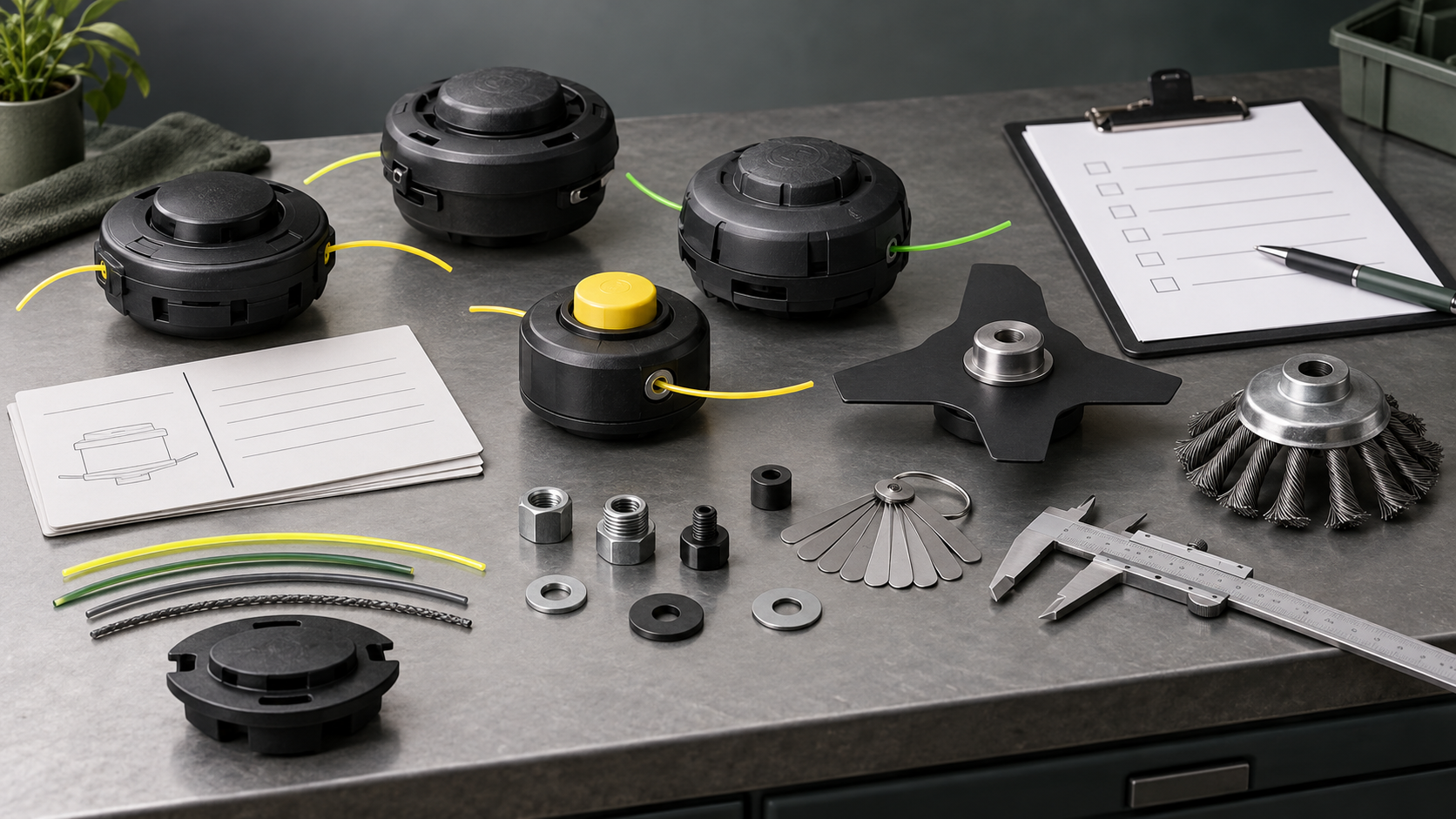
Trimmer head sourcing gets expensive when compatibility data is vague
A distributor can receive a request for a trimmer head with little more than a machine name, a photo, or a familiar-looking thread description. That may be enough to begin a search, but it is not enough to approve an item for a catalog or purchase order. Similar housings can hide different drive connections, thread directions, mounting hardware, cutting systems, and application limits.
For importers, wholesalers, aftermarket retailers, dealers, and repair networks, the practical goal is to build one reviewable evidence row per requested item. This guide shows how to evaluate wholesale trimmer heads without treating appearance, a product name, or a cross-reference as automatic proof of fitment.
Define the requested head before comparing suppliers
Start with the buyer’s use case, not a supplier’s nearest visual match. A product request should distinguish the equipment application, the drive connection, the cutting system, and the commercial unit. Keep original customer wording in a source field and normalize it only in separate working columns.
| Review layer | Buyer question | Evidence to request |
|---|---|---|
| Application | Which machine or approved application is this row intended for? | Model, series, original reference, and source document or labeled photo |
| Drive interface | How does the head attach to the equipment? | Connection type, measured dimensions, pitch where relevant, direction, and included hardware |
| Cutting system | What type of cutting media and feed arrangement does the request require? | Controlled description, line or cutting-media details, loading method, and buyer requirements |
| Commercial scope | What exactly is being quoted? | Piece, set, or kit definition; included components; packaging request; quantity |
Use an eight-point trimmer head compatibility checklist
1. Preserve original references and their source
Record the original part number, punctuation, suffixes, and the source of the request exactly as received. Keep a buyer SKU and a supplier candidate code in separate fields. If a machine model or reference came from a customer message rather than controlled documentation, label that source clearly. Traceability matters when a later review uncovers a wrong digit or an application variation.
2. Capture the complete equipment context
Ask for the equipment type, model, series, and any configuration details that the requester can verify. A model family may contain more than one attachment arrangement, so do not widen compatibility beyond the supplied evidence.
3. Describe the drive connection precisely
The attachment interface deserves its own controlled fields. Record whether the observed connection is internal, external, adapter-based, or another clearly described arrangement. Where threaded interfaces are involved, capture measured diameter, pitch, and direction using named measurement methods. Do not infer direction from a photo or convert a close measurement into a nominal specification without review.
4. List every mounting component in the quote scope
A head alone, a head with an adapter, and a complete mounting set are different commercial units. Ask the trimmer head supplier to identify included adapters, washers, nuts, covers, or other hardware that forms part of the quoted item. Use “not included” and “not confirmed” as distinct values. This prevents buyers from comparing a complete set with a bare component as if they were equivalent.
5. Control the cutting and feed description
State whether the inquiry concerns a line head or another cutting-head format, then document the requested loading or feed arrangement in buyer-approved language. If line is included, define that scope separately from the head. Avoid generic labels such as “universal” unless the supplier explains the supported interface and the buyer independently approves the intended application.
6. Record dimensions with named reference points
Terms such as diameter, height, or opening can be ambiguous without a sketch or labeled image. Define the start and end points, the unit, and whether the value comes from a sample, drawing, product page, or supplier response.
7. Tie photos and documents to one RFQ row
Give each requested item a stable row ID. Use it in filenames for the overall view, drive-interface close-up, measurement images, application reference, and packaging example. Do not place unlabeled photos from several replacement trimmer heads in one message thread and expect purchasing teams to reconstruct which evidence belongs to which item.
8. Define quantity, unit, packaging request, and open questions
State the requested quantity and the unit being counted. Write packaging and labeling needs as requests rather than assumed capabilities. Add an exception column for every unresolved fitment, scope, or document question, and require that exceptions remain visible through approval. An unanswered field should never be silently treated as confirmation.
Build one controlled RFQ row per requested item
A practical trimmer-head worksheet can include:
- buyer row ID, original reference, source, and internal SKU;
- equipment type, model, series, and verified application context;
- head format and cutting or feed description;
- drive connection type, dimensions, pitch and direction where relevant;
- required adapters, mounting hardware, and included-component scope;
- controlled dimensions with units and named reference points;
- photo, drawing, sample, or product-page evidence references;
- requested quantity, commercial unit, packaging request, and destination needs;
- supplier candidate code, exceptions, review status, and approver.
If the order combines several outdoor-equipment categories, the guide to consolidating outdoor power equipment parts orders offers a useful row-control approach. The same discipline applies here: keep requested items, proposed alternatives, evidence, and approvals separate even when they travel in one sourcing project.
See where weak fitment data creates hidden cost
Visual similarity can produce a false match
Two heads can share a general silhouette while using different attachment details or included hardware. If a photo-only candidate reaches the catalog, teams may need to reopen the search, correct listings, answer branch complaints, and process avoidable returns. A clear interface record is cheaper than reconstructing the decision after a problem appears.
An undefined “universal” label shifts risk to the buyer
A broad label is not a substitute for an approved application list or a documented adapter arrangement. Buyers should ask what the supplier means, compare that explanation with the intended equipment, and record the approval boundary. Marketing language should not become an uncontrolled fitment claim.
Mixed quote units distort price comparisons
A single head, a head-and-adapter set, and a packaged kit can carry different prices because their scopes differ. Normalize included items, commercial units, and requested packaging before comparing offers. Otherwise the lowest number may represent the narrowest quote rather than the best purchasing option.
Uncontrolled substitutions weaken catalog trust
An alternative may help fill an assortment gap, but it needs its own candidate record and evidence. Do not overwrite the originally requested item with a supplier suggestion. Keep the relationship visible so catalog, purchasing, and technical reviewers can see what changed and why.
Compare suppliers on evidence quality as well as price
Send the same worksheet to each candidate and score the response against the same fields. A useful reply identifies the proposed item, answers the requested interface and scope questions, separates confirmed facts from open points, and makes exceptions easy to find. A fast price with an ambiguous drive connection can create more work than a response that exposes missing data early.
For a new range, stage the review. Begin with high-demand references and rows supported by the clearest application evidence. Keep uncertain items out of the approved catalog until the defined review is complete. If samples are part of the buyer’s normal process, decide in advance which fitment, component, packaging, and recordkeeping checks must be documented. The checklist supports that decision; it does not replace it.
Where Yeahparts fits
Yeahparts presents aftermarket replacement parts for outdoor power equipment. Its current trimmer head collection includes model-referenced and general-format listings, while the adjacent brush cutter and strimmer parts category provides context for broader inquiries. Buyers can submit a controlled list and ask which current listings or alternatives fall within the available product scope. Application, interface, included components, packaging, and commercial terms still require confirmation for each inquiry.
Buyer FAQ
Is a machine model enough to approve a trimmer head?
No. It is useful application evidence, but buyers should also verify the drive interface, relevant dimensions, thread details where applicable, mounting hardware, cutting system, and quote scope for the requested configuration.
Which interface details belong in a trimmer-head RFQ?
Describe the connection type and include measured dimensions, pitch and direction where relevant, required adapters, and all mounting components. Name the measurement points and show the interface in labeled photos or controlled documentation.
Can a buyer rely on the word “universal”?
No. Ask the supplier to define the supported connection or adapter arrangement and then review the intended equipment application. Record the approved boundary instead of copying a broad label into the catalog.
How should two similar candidate heads be compared?
Keep them as separate rows. Compare their application evidence, drive interfaces, included hardware, cutting systems, dimensions, commercial units, and exceptions. Record why one was approved, rejected, or left unresolved.
What makes a wholesale trimmer head inquiry easier to review?
Use one row per item, exact source references, labeled evidence, defined interfaces and measurements, requested quantity and unit, included-scope questions, and a visible exception field. This gives both buyer and supplier a common record.
Prepare a focused trimmer-head list for supplier review
Organize each application, source reference, interface, measurement, cutting system, included component, quantity, unit, packaging request, and open question in one controlled file. Send that focused trimmer-head list to Yeahparts for a current product-scope and quotation review.




Add comment