
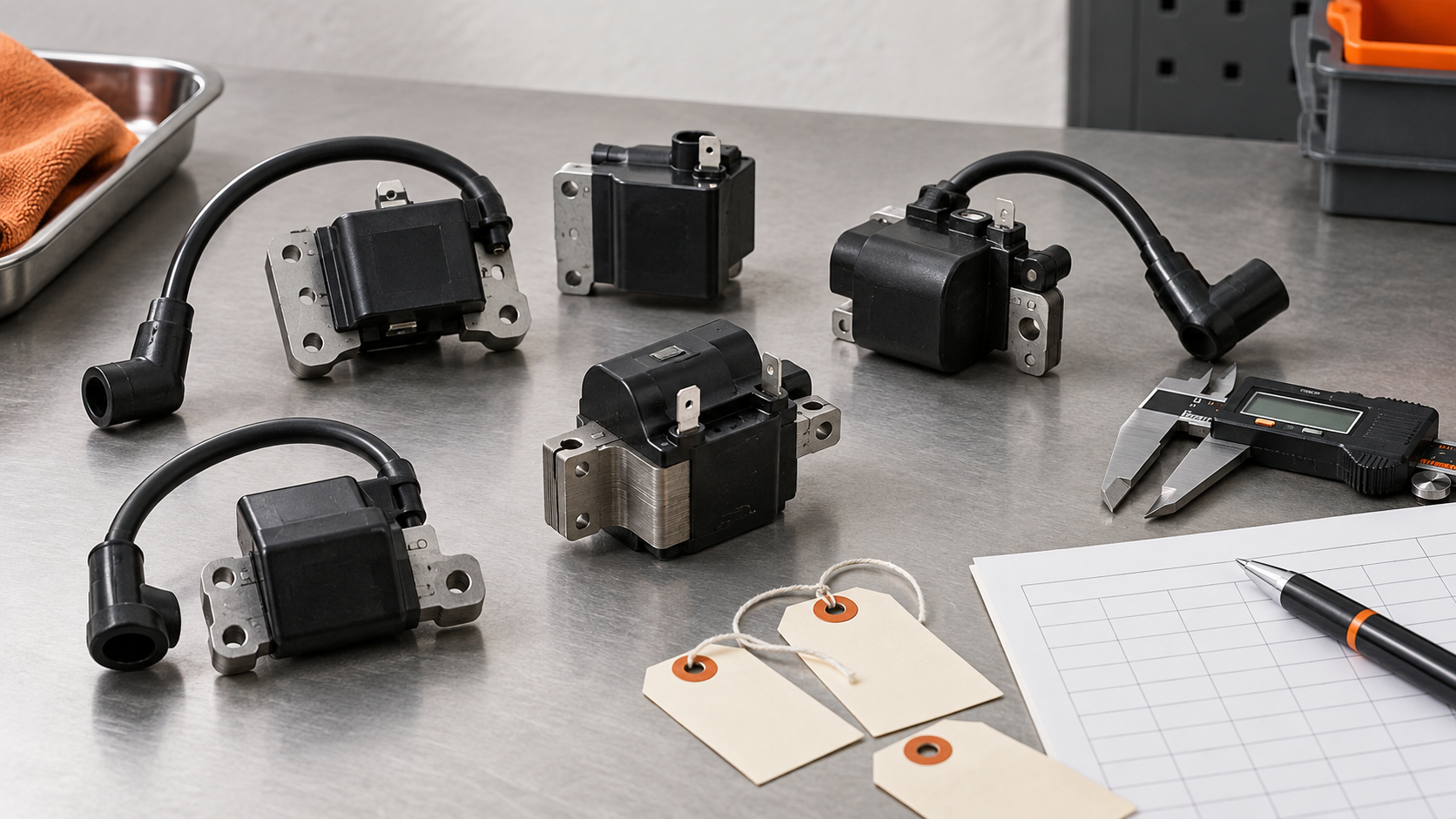
Ignition coil sourcing breaks down when one reference carries too much trust
A buyer may receive an ignition coil request as a part number, a machine model, a photograph, or a sample with no traceable label. Each can help start an inquiry, but none should become an automatic approval. Similar-looking modules can differ in mounting geometry, lead arrangement, terminal details, application scope, and the commercial unit included in a quote.
For dealers, distributors, importers, aftermarket retailers, and repair networks, the purchasing task is not simply to find a plausible match. It is to create a record that catalog, technical, purchasing, and receiving teams can review later. This checklist explains how to compare wholesale ignition coils as aftermarket replacement parts while keeping confirmed evidence, assumptions, and open questions separate.
Define the requested item before comparing supplier offers
Keep the buyer’s original reference exactly as received, then build a separate normalized row for comparison. Do not silently remove punctuation, merge suffixes, or replace the requested item with a supplier candidate. The request and the proposal are two different records until the buyer approves the relationship.
| Review layer | Buyer question | Evidence to request |
|---|---|---|
| Application | Which equipment, model, series, or engine is the item intended for? | Original reference, model context, source document, or labeled sample photo |
| Physical interface | Does the module match the required mounting and lead arrangement? | Controlled dimensions, mounting-hole locations, lead routing, terminal views, and named reference points |
| Commercial unit | What exactly is included in the quotation? | Module, attached lead or boot where applicable, accessory scope, packaging request, and unit of sale |
| Approval status | Which facts are confirmed and which remain open? | Exception list, evidence source, reviewer, date, and approval boundary |
Use a nine-point ignition coil fitment checklist
1. Preserve the original reference and its source
Record the original part number, spaces, dashes, suffixes, and source. Note whether it came from a buyer file, equipment label, prior invoice, sample, or another document. Put any cleaned or normalized version in a separate field so the source trail remains intact.
2. Capture the full application context
Ask for the equipment type, model, series, engine reference, and any configuration details the buyer can verify. A reference used across a family of equipment should not be widened to every model in that family without supporting evidence. Keep the approved application boundary visible in the catalog record.
3. Separate requested and proposed part numbers
Use one field for the buyer’s requested reference and another for the supplier’s candidate. If an ignition coil supplier proposes a cross-reference or alternative, retain it as a candidate relationship. Do not overwrite the original request or describe equivalence as confirmed until the buyer completes its review.
4. Record mounting geometry with named points
Photographs can help orient the review, but measurements need defined start and end points. Capture the relevant mounting-hole arrangement, spacing, body position, and any clearance-sensitive features using a labeled image or drawing. State the unit and evidence source for every value.
5. Document the high-tension lead arrangement
Where the module includes a lead or boot, record its routing, exit direction, connector form, and the dimensions the buyer considers important. Distinguish a supplied component from a buyer-requested component that has not yet been confirmed. Avoid assuming that a similar body automatically carries the same lead arrangement.
6. Show terminals and connections clearly
Ask for close, well-lit views of terminals, tabs, wires, and connection points. Use buyer-approved names in the worksheet, and flag any terminology that remains uncertain. A clear image tied to one RFQ row is more useful than a folder of unlabeled close-ups.
7. Control orientation in every image
Use the same viewing sequence for each candidate: overall view, mounting face, opposite side, lead exit, terminals, and measurement views. Include a row ID in the filename or image label. This reduces the risk of comparing one candidate’s dimensions with another candidate’s photographs.
8. Define the quotation scope
State the requested quantity and unit, then ask what the quoted unit contains. Packaging and labeling requirements should be written as requests, not assumed capabilities. If the inquiry includes mixed ignition coil modules, require a separate line for each reference so price, scope, and unresolved questions remain traceable.
9. Keep exceptions open until an authorized review closes them
Use explicit values such as confirmed, not confirmed, not applicable, or buyer review required. Blank cells should not be treated as agreement. The worksheet should show who reviewed the evidence, when it was reviewed, and the exact application or catalog boundary that was approved.
Build one controlled comparison row per candidate
A practical worksheet for aftermarket replacement ignition coils can include:
- buyer row ID, original reference, original wording, and evidence source;
- equipment type, model, series, engine context, and approved application notes;
- supplier candidate code and stated cross-reference relationship;
- mounting geometry, controlled dimensions, units, and measurement points;
- body orientation, lead arrangement, boot or connector details where applicable;
- terminal and wire photographs tied to the row ID;
- quoted unit, included components, quantity, packaging request, and destination needs;
- exceptions, reviewer, decision, date, and approval boundary.
If several teams maintain the same catalog, the guide on controlling mower-parts cross-reference data provides a compatible recordkeeping framework. Its central discipline applies here too: preserve source evidence, separate proposed relationships from approved ones, and make changes traceable.
See where weak fitment data creates hidden cost
A visual match can create a false approval
Two modules may share a general silhouette while differing in an interface or application detail. If purchasing approves from an unlabeled photo, downstream teams may need to reopen the inquiry, correct catalog data, answer branch questions, or process returns. A controlled evidence row makes the decision easier to audit before stock is committed.
A cross-reference without provenance can spread through the catalog
Once an unreviewed relationship enters a master file, it can be copied into price lists, marketplace records, and reorder sheets. Preserve the source and approval status beside every relationship. When evidence changes, update the relationship rather than erasing its history.
Undefined quote scope distorts price comparisons
One offer may cover a module only, while another includes an attached component or different packaging scope. Normalize the commercial unit and included items before comparing prices. Otherwise the lowest number may represent a narrower offer rather than a better sourcing choice.
Unresolved exceptions become receiving problems
If a lead arrangement, terminal view, or application boundary is unclear during quotation, it will not become clearer simply because a purchase order was issued. Keep the exception visible and assign an owner. A deliberate hold is less disruptive than discovering the ambiguity after arrival.
Compare suppliers on evidence quality, not only response speed
Send the same worksheet to each candidate. A useful response identifies the proposed item, answers the requested data fields, supplies row-specific images or documents, distinguishes confirmed facts from open points, and explains substitutions without rewriting the buyer’s request. Speed matters, but a quick price attached to weak evidence can transfer review work and risk back to the buyer.
For a new range, begin with references that have clear source data and meaningful buyer demand. Review a manageable group, close exceptions, and only then extend the method to adjacent applications. If samples are part of the buyer’s normal process, define the inspection record before requesting them. The checklist organizes a purchasing decision; it does not replace the buyer’s technical approval process.
Where Yeahparts fits
Yeahparts presents aftermarket replacement parts for outdoor power equipment. Its current ignition coil modules category includes application- and reference-based listings for several equipment types, while the chainsaw parts category gives buyers an adjacent product-scope view. Buyers can submit a controlled list and ask which current listings or alternatives fall within the available range. Fitment, included scope, packaging, and commercial terms still require confirmation for each inquiry.
Buyer FAQ
Is an original part number enough to approve an ignition coil?
No. It is a valuable starting reference, but buyers should also confirm the intended application, source, mounting geometry, lead and terminal arrangement, quoted unit, and any open exceptions.
Can a product photo confirm fitment?
A photo can support review, but it should be tied to one candidate and accompanied by controlled dimensions, reference data, and application context. General visual similarity is not proof of interchangeability.
How should a supplier-proposed alternative be recorded?
Keep the original requested reference unchanged. Add the proposed item in a separate candidate field, attach the supplier’s evidence, record differences and open questions, and wait for the buyer’s authorized approval before publishing the relationship.
What belongs in an ignition coil RFQ?
Include the original reference and source, equipment context, required views and measurements, lead and terminal details, quantity and unit, included-scope questions, packaging request, destination needs, and an exception field.
How can distributors compare several coil offers consistently?
Use the same row structure and evidence requirements for every supplier. Normalize the quoted unit, keep candidates separate, score completeness, and compare only after unresolved fields are visible.
Prepare a focused ignition coil list for review
Organize each source reference, application, candidate code, mounting measurement, lead and terminal view, quantity, unit, packaging request, and open question in one controlled file. Send that focused ignition coil list to Yeahparts for a current product-scope and quotation review.




Add comment