
Seasonal demand exposes weak inventory decisions
For a dealer or distributor, the busy mower season rarely fails because there are too few total parts on the shelf. More often, the problem is that stock is concentrated in the wrong references, fitment data is incomplete, or a replenishment decision arrives after demand has already accelerated. A practical seasonal lawn mower parts inventory plan connects sales history, installed-base knowledge, supplier readiness, and clear reorder rules.
The goal is not to predict every repair. It is to decide which items deserve depth, which should remain controlled, and which can be sourced after a confirmed order. That distinction protects working capital while helping the sales counter respond quickly when customers need common replacement parts. The framework below is designed for dealers, wholesalers, importers, and aftermarket parts retailers managing a mixed assortment.
Start with a demand timeline, not a single preseason order
One large purchase order can create the appearance of preparation, but it does not create a complete plan. Divide the season into four operating windows: review, build, peak, and closeout. During the review window, clean the part-number file and identify last season’s recurring gaps. During the build window, confirm core references and place the orders needed to support the opening weeks. During peak, use shorter review cycles and protect the fast-moving lines. During closeout, reduce speculative replenishment and document what should change next year.
Use local demand signals rather than a generic calendar. Weather patterns, equipment mix, commercial mowing activity, and the timing of dealer promotions can shift the curve. The important point is to define dates for decisions: when forecasts freeze, when supplier confirmations are due, when reorder thresholds change, and when slow-moving purchases require extra approval.
Classify every SKU by service role
ABC analysis based on sales value is useful, but parts buyers also need to consider service urgency and substitution risk. A low-value component can still cause a lost sale if it stops a machine and has no practical alternative. Add a service-role classification to the financial view.
| Inventory tier | Typical role | Planning approach |
|---|---|---|
| Core seasonal | Frequently requested references with clear fitment | Hold planned depth and review frequently during peak |
| Service critical | Items that can stop a repair even at lower volume | Set a protected minimum and confirm replenishment options |
| Range support | References that complete a category or support a mixed fleet | Carry controlled quantities based on local equipment coverage |
| Special order | Low-frequency or uncertain-fitment items | Source against confirmed demand instead of forecasting deeply |
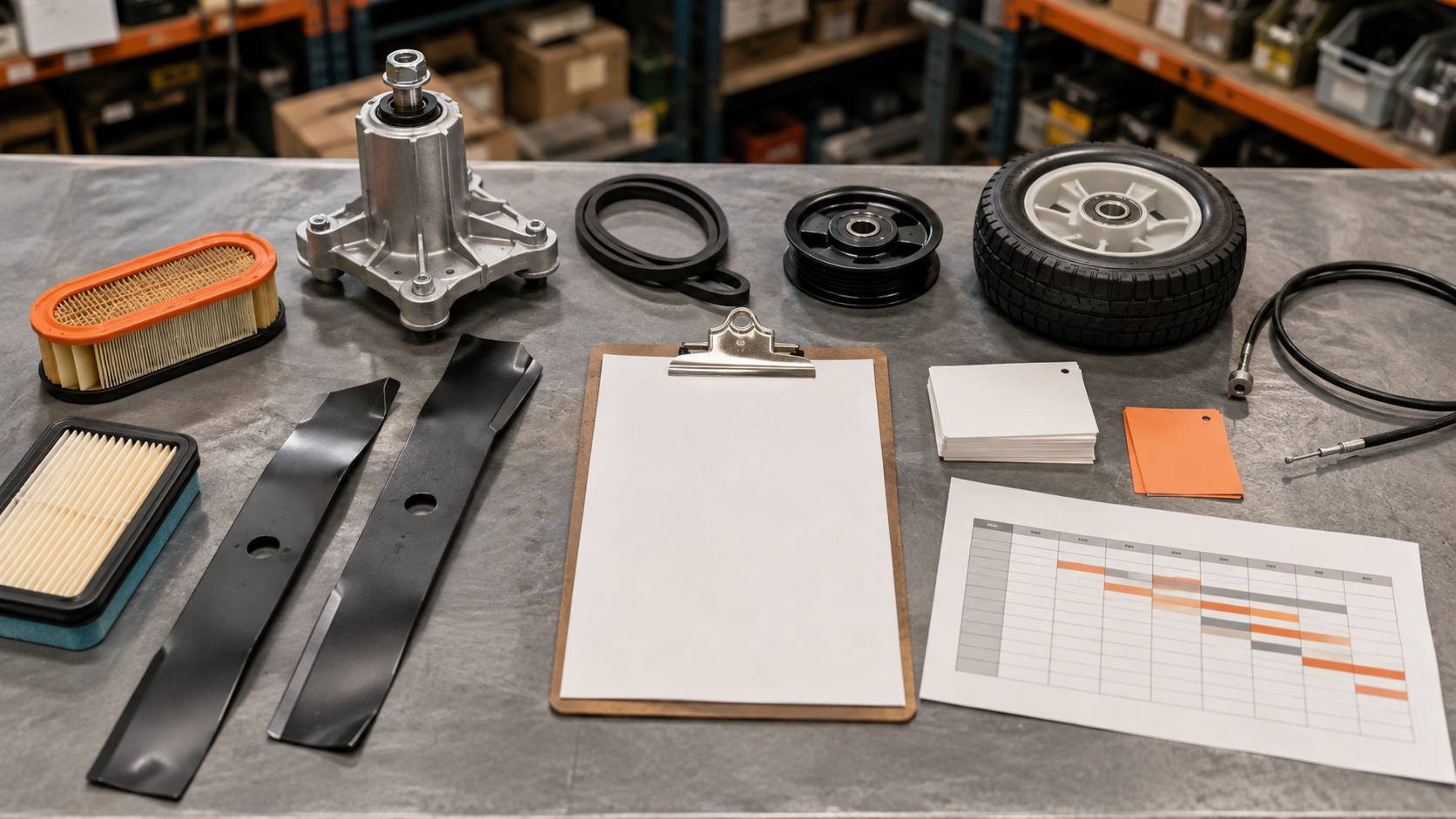
Apply the same logic across related categories. The live lawn mower parts range provides a useful map for assortment planning. Within that range, categories such as mower spindles and lawn mower blades may need different depth, review frequency, and fitment controls. Avoid giving every category the same stocking rule simply because it serves the same equipment type.
Make fitment data part of the inventory decision
A forecast is only as useful as the item master behind it. Before increasing quantities, check that each proposed reference has a stable internal SKU, supplier reference, cross-reference source, compatible equipment information, key dimensions where applicable, pack quantity, and image. Record the source and date of any fitment update so the buying and sales teams can resolve conflicts instead of relying on memory.
Separate confirmed fitment from customer-supplied or unverified cross-references. That simple status field prevents an uncertain match from being treated as established data throughout the catalog. When two references appear interchangeable, compare the attributes that matter to the specific part rather than matching only on a familiar number or similar appearance.
Good data also improves forecasting. If duplicate SKUs represent the same application, demand may look artificially fragmented. If one SKU has been used for several different applications without clear notes, the apparent velocity may be misleading. Clean the cross-reference table before using last year’s transactions as the basis for this year’s purchase quantities.
Plan supplier continuity before the peak
Inventory depth cannot compensate for an unclear supply path. For each core or service-critical item, record the approved source, quotation validity, pack configuration, order status, expected dispatch information, and the internal owner responsible for follow-up. Where a second source exists, verify its product data independently rather than assuming the same reference means the same specification.
Ask suppliers to respond in a comparable format. A useful request includes part numbers, required quantities, fitment notes, packaging requirements, destination, and the date by which a decision is needed. Structured requests make quote comparison easier and reveal missing information early. A broader discussion of category evaluation is available in this outdoor equipment parts guide for dealers.
Do not wait for peak demand to discover that a carton quantity, labeling requirement, or document field differs from your system. Resolve those operational details during the build window and record the agreed version in the purchase file.
Use reorder triggers that change with the season
A static minimum can be too low during the busiest weeks and too high near the end of the season. Set a normal trigger and a peak trigger for the items that matter most. The calculation can remain simple: expected demand during replenishment, plus a buffer that reflects demand variability and supply uncertainty. The inputs should be reviewed, not treated as permanent facts.
Track a small group of exception signals every week: sales above plan, open customer orders, delayed purchase lines, unusually high returns, repeated fitment questions, and stock that has stopped moving. Exceptions deserve action; a large dashboard that nobody reviews does not. Assign an owner and a decision for each exception, such as expedite, substitute after verification, hold, reduce the next order, or investigate the product record.
During peak weeks, review core seasonal and service-critical items more often than range-support stock. As the season closes, tighten approval for replenishment that may arrive after demand fades. This is how a mower parts stocking plan becomes a working control system rather than a preseason spreadsheet.
Run a preseason readiness review
- Confirm the opening assortment by inventory tier and local equipment coverage.
- Merge duplicate SKUs and flag uncertain cross-references.
- Check product images, dimensions, pack quantities, and supplier references.
- Identify core items with only one approved supply path.
- Set normal, peak, and closeout review rules.
- List open quotations, samples, and unresolved fitment questions.
- Define who can approve an expedite, substitute, or late-season buy.
- Prepare a weekly exception report for sales, purchasing, and customer service.
Complete the review with the people who see different parts of the demand signal. Sales knows which inquiries are increasing, service teams know which failures stop a repair, and purchasing knows where information or confirmations are still missing. One shared list is more reliable than separate assumptions.
Where Yeahparts fits
Yeahparts supplies aftermarket replacement parts across lawn mower and other outdoor power equipment categories. For buyers building a seasonal program, the most productive starting point is a focused list: part numbers, required quantities, known applications, category priorities, packaging notes, and destination. That gives both sides a concrete basis for checking the range and clarifying the request.
Use the same discipline for an initial category review and for later replenishment. Keep approved data attached to the SKU, and feed sales, fitment, and delivery outcomes back into the next forecast. The supplier conversation should support the inventory process, not replace it.
Frequently asked questions
When should dealers begin seasonal mower-parts planning?
Begin early enough to clean product data, review prior demand, collect quotations, resolve fitment questions, and make buying decisions before the local sales curve rises. The exact calendar depends on the market, supply route, and equipment mix, so work backward from the required shelf-ready date.
Which mower parts should receive the deepest stock?
Give depth to references with repeatable demand, reliable fitment, and a clear service role. Do not use unit sales alone. Consider whether an item stops a repair, whether alternatives exist, how quickly it can be replenished, and how much uncertainty remains in the product data.
How can a distributor reduce overstock after the season?
Use staged purchasing, separate peak and closeout reorder rules, and require extra review for replenishment that may arrive late. Monitor slow movement while there is still time to adjust future orders, and carry lessons into the next planning cycle.
What information should be sent with a supplier inquiry?
Send a structured list containing part numbers, quantities, known equipment applications, dimensions or reference details where relevant, packaging needs, destination, and the required decision date. Mark uncertain matches clearly so they can be reviewed before an order is finalized.
Build the next seasonal plan from a focused list
A resilient inventory plan begins with clean references and explicit priorities. Send Yeahparts your focused part-number list for a category and quotation review.





Add comment