
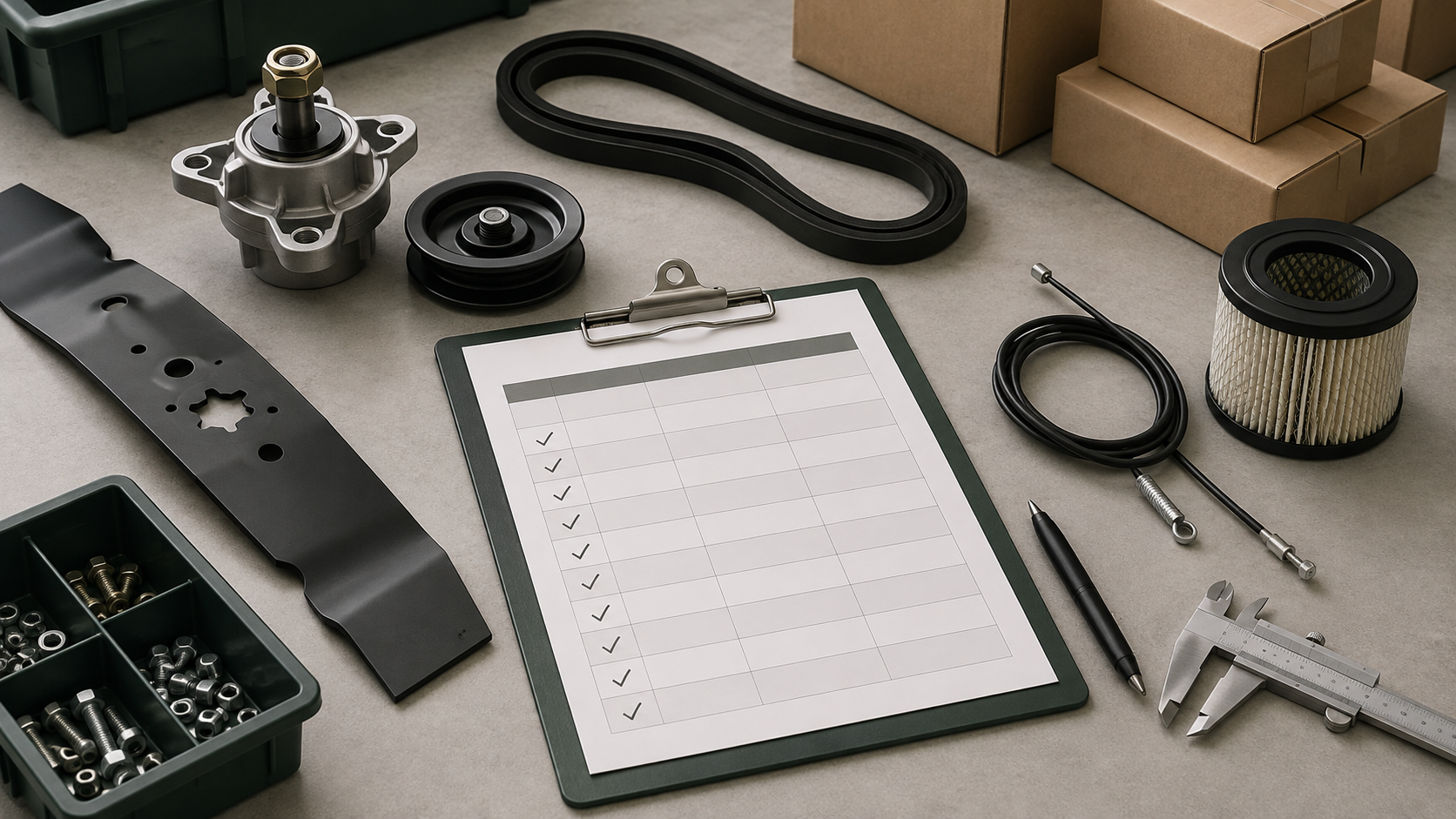
A clear RFQ protects more than quote speed
When a dealer or distributor needs pricing on dozens of mower references, the first pressure is usually time. Sales wants an answer, seasonal demand is approaching, and purchasing needs comparable offers. Yet sending a spreadsheet with only familiar part numbers and quantities often creates a longer clarification cycle. Suppliers may interpret references differently, quote different pack units, or leave uncertain applications unresolved.
A useful aftermarket mower parts RFQ gives each supplier the same decision-ready information. It separates known fitment from assumptions, makes commercial requirements visible, and creates a record that purchasing, catalog, and receiving teams can follow. The goal is not to make the request longer. It is to make every field earn its place by reducing ambiguity before an order decision.
Use one row per purchasable item
Start with a controlled spreadsheet rather than a message thread. Each row should represent one item as it would be quoted, purchased, received, and entered into your system. If the same component is needed in different pack configurations or under different labeling instructions, use separate rows so those differences cannot disappear inside a note.
| Weak request | Quote-ready request | Why it matters |
|---|---|---|
| One reference number | Buyer SKU, reference number, and reference type | Prevents an internal code from being mistaken for a fitment reference |
| Model name only | Known application plus the source and status of the match | Separates confirmed data from a lead that still needs review |
| Quantity without unit | Required quantity and purchasing unit | Keeps pieces, sets, and packs from being compared as if they were equal |
| “Standard packaging” | Required labeling and packaging information | Shows what must be clarified before the quote is accepted |
| Price request only | Price, pack, availability, dispatch basis, and quote validity fields | Creates a comparable commercial response |
Lock the column names before sending the file. If suppliers return different formats, copy the answers into a single comparison sheet without changing the original response. This preserves the source while giving the buying team one consistent view.
Identify every reference and its evidence
Include your internal SKU when one exists, the supplier reference you are asking about, and any cross-reference used to find it. Label each number by type. A supplier part number, an equipment reference, and a buyer-created SKU may look similar in a spreadsheet but serve different purposes.
Add a fitment-status field with plain values such as confirmed, buyer-provided, or review required. Then record the source available to your team: a current catalog entry, product page, service document, sample record, or prior approved purchase. Do not convert an unverified cross-reference into a confirmed application merely because the numbers appear together online.
For broad category work, the live lawn mower parts range can help buyers divide an inquiry into spindles, pulleys, wheels, blades, belts, cables, and other groups. Category separation matters because the attributes needed to review one component may be irrelevant to another.
Ask for the attributes that control fitment
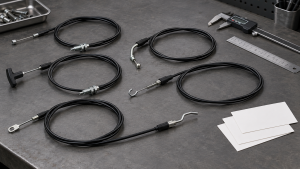
Do not use one generic specification column for every product family. Instead, create category-specific fields based on the information your catalog and receiving teams actually need. A mower blade request may depend on overall length, center-hole style, outer-hole details, width, and application references. A belt request needs its own identifying dimensions and profile information. A cable request may require end styles, lengths, routing notes, and application context.
Spindles demonstrate why a photograph alone is not enough. Buyers may need reference numbers, mounting pattern information, pulley context, shaft details, and deck application notes before treating a match as usable. Review the live mower spindle collection to see how specific references and applications distinguish product listings, then build your RFQ fields around the evidence your own team requires.
Use photos as supporting evidence, not as a substitute for data. Name image files with the buyer SKU or row number so they remain connected to the request. If a measurement has not been checked, leave it blank and mark it for clarification rather than estimating it from an image.
Make quantities and commercial terms comparable
For each row, state the requested quantity and the unit in which you expect the quote. If the quantity is a forecast rather than a firm buying requirement, label it accordingly. Separate an evaluation quantity from a repeat-order estimate; otherwise a supplier cannot tell which figure should guide the immediate quotation.
At the request level, provide the destination country or port information available to you, preferred quotation basis, currency, and the date by which purchasing needs the response. Ask suppliers to state pack configuration, quote validity, availability status, and dispatch information instead of assuming these items are included. Do not enter a desired answer into the template as if it were already confirmed.
Packaging and labeling requirements should also be explicit enough for comparison. List the data your operation needs on an item label or carton, any barcode file you will supply, and whether retail presentation is part of the request. If these requirements are undecided, identify them as open questions. Hidden packaging assumptions can turn a low-looking unit price into an incomplete comparison.
Build a comparison matrix before replies arrive
Design the evaluation sheet at the same time as the mower parts quotation request. This prevents price from becoming the only organized field while fitment risk and commercial gaps remain scattered across emails.
- Identity: Does the response preserve the buyer SKU and requested reference?
- Fitment: Which applications are confirmed, qualified, or still unresolved?
- Specification: Are the category-specific attributes complete enough for review?
- Commercial basis: Are price, currency, unit, pack, and quote validity stated?
- Supply response: Is availability or dispatch information clear enough for the planned buying window?
- Operations: Are labeling, packaging, documentation, and destination questions answered?
- Exceptions: Are substitutions, unavailable lines, or alternative references clearly identified?
Compare like with like. If one supplier quotes a set and another quotes a piece, normalize the unit before evaluating price. If one response includes unresolved fitment, do not score it as equivalent to a row supported by the evidence your business requires. The matrix should make uncertainty visible rather than hide it inside a total.
Account for the cost of missing information
An incomplete RFQ creates costs even before anything ships. Buyers spend time reconciling formats, product teams reopen fitment questions, and suppliers prepare revised quotations. After an order, the same ambiguity can appear as incorrect catalog records, receiving exceptions, sales disputes, or stock that cannot be confidently assigned to an application.
More detail is not automatically better. Copying every note your company has ever collected can bury the fields that control a decision. Use a minimum-data rule: include what is needed to identify the item, review fitment, compare the commercial offer, and execute the next purchasing step. Put background material in referenced attachments and keep the main sheet scannable.
RFQ quality also supports inventory planning. Clean identifiers and explicit units make it easier to connect a quote to demand tiers and reorder rules. Buyers building a seasonal program can use the related seasonal mower-parts inventory framework to decide which references deserve deeper review and which should remain controlled or special-order items.
Run a final RFQ check
- Give the request a version number, owner, issue date, and response deadline.
- Use one row per purchasable item and keep units explicit.
- Label every reference number by type.
- Separate confirmed fitment from buyer-provided or unverified matches.
- Include category-specific attributes instead of one generic specification note.
- Connect supporting images and documents to a row or buyer SKU.
- State quantities, purchasing units, destination information, and quotation basis.
- Provide dedicated fields for pack, availability, dispatch basis, and quote validity.
- List labeling or packaging requirements without presenting open points as agreements.
- Require suppliers to flag substitutions and unanswered fields.
- Prepare the comparison matrix before distributing the request.
- Have purchasing and product-data owners review the same final version.
Keep a frozen copy of the issued file. When questions arise, record the clarification and distribute an updated version rather than silently changing cells. Version control protects both sides from quoting against different assumptions.
Where Yeahparts fits
Yeahparts presents aftermarket replacement parts across lawn mower and other outdoor power equipment categories. Buyers can use the live category pages to organize a focused part-number list. Product availability, compatibility, commercial terms, and other order details should still be confirmed for the actual inquiry rather than inferred from a category page.
Frequently asked questions
Should an RFQ include equipment model information?
Include model or deck information when it helps identify the application, but pair it with the reference source and fitment status. Model names alone may not capture production changes or component differences, so keep unresolved matches visible.
How should alternative part numbers be handled?
Place the requested reference in its own field and ask suppliers to identify any proposed alternative separately. The alternative should not overwrite the original request. That allows the buyer to review supporting data before accepting a substitution.
What is the best format for a multi-item mower parts RFQ?
A controlled spreadsheet works well for line-level data, supported by clearly named images or documents where necessary. Use stable columns, dropdown values where practical, and a separate instruction sheet for request-level terms.
Should target prices be included?
That is a commercial choice. If a target is used, label its currency, purchasing unit, and basis clearly. Never let a target replace the need to collect comparable pack, availability, dispatch, and validity information.
Turn your parts list into a reviewable inquiry
A strong B2B mower parts sourcing request begins with traceable references and visible assumptions. Send Yeahparts your focused part-number list for an aftermarket mower parts RFQ review.



Add comment