
Pulley sourcing problems usually begin before the quote
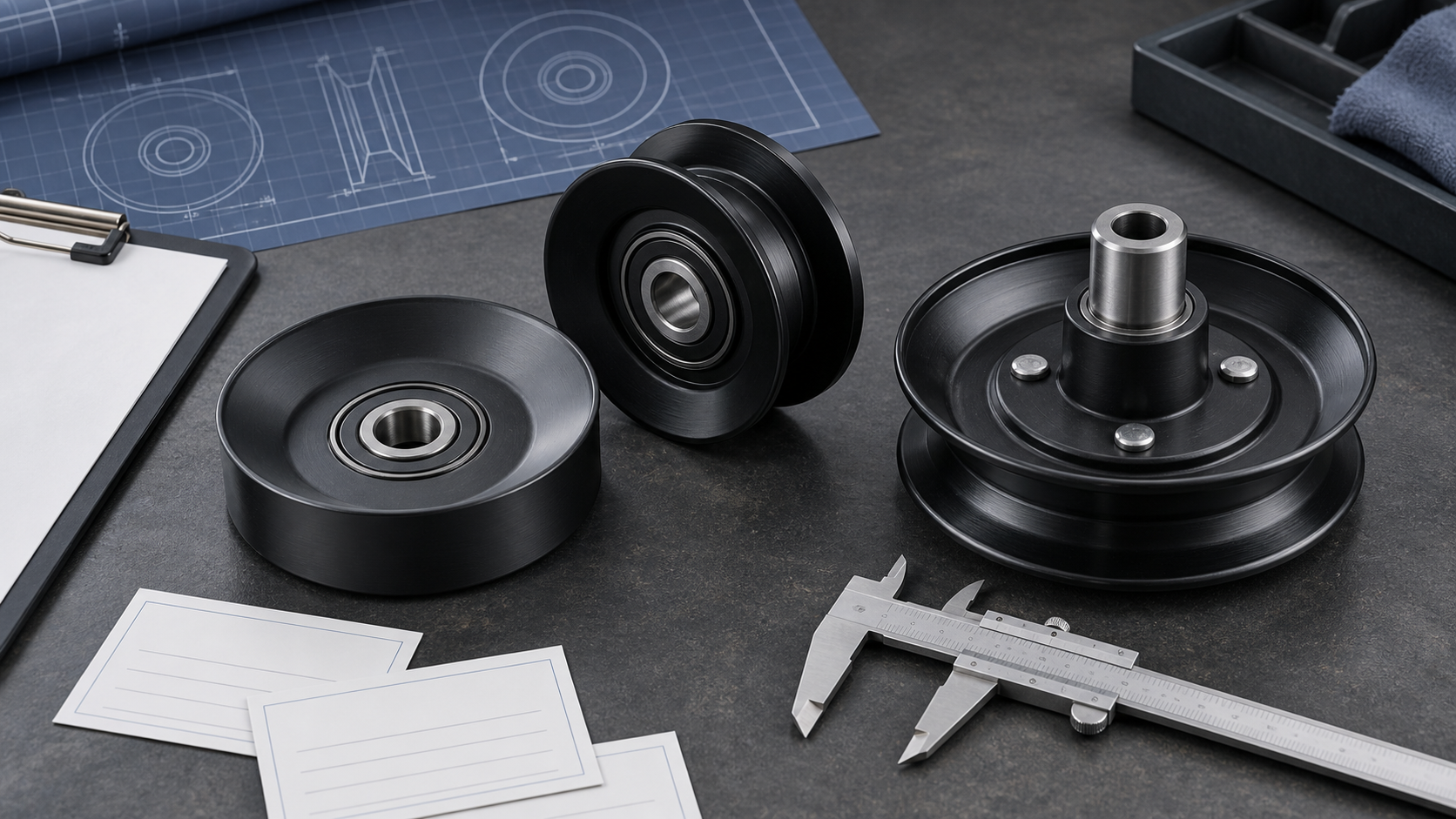
A pulley line can look simple in a spreadsheet: reference, description, quantity, and target price. The problem appears when purchasing, catalog, and supplier teams attach different meanings to the same short description. A smooth idler, V-groove idler, or spindle pulley may share a similar outside diameter while differing in belt contact, bore, hub position, bearing arrangement, or mounting interface. A visually close candidate can therefore create extra review work without becoming a usable match.
Buyers comparing wholesale lawn mower pulleys need a row-level data structure that connects every requested item to its function, application context, measurable attributes, evidence, and commercial unit. This checklist helps dealers, distributors, importers, aftermarket retailers, and repair networks prepare that structure before requesting a quotation.
Start by defining the pulley role
Do not begin with diameter alone. First classify how the pulley works in the mower system and how the belt contacts it. This narrows the comparison fields and prevents unlike components from entering the same review group.
| Pulley group | Initial buyer question | Data to clarify next |
|---|---|---|
| Smooth idler | Does the back of the belt contact the pulley surface? | Outside diameter, face width, bearing or bore, mounting, and offsets |
| V-groove idler | Does the belt ride inside a defined groove? | Groove profile, diameter, width, bearing or bore, and mounting position |
| Spindle or deck pulley | How does the pulley connect to the spindle or shaft? | Bore profile, key or spline detail when applicable, hub geometry, and related deck context |
| Assembly-linked pulley | Is the request for a pulley alone or a larger assembly? | Included hardware, spacers, bearings, brackets, and unit of sale |
The classification is a starting point, not proof of fitment. Use the terminology accepted by your organization, and keep uncertain rows marked for review.
Build an eight-part fitment data checklist
1. Preserve the requested reference exactly
Keep the original reference, including prefixes, suffixes, spaces, and punctuation. If your system also needs a normalized search value, store it in a separate field. Add the source of the reference and the buyer’s internal SKU when one exists. This makes later corrections traceable instead of turning the original request into an overwritten guess.
2. Add the application context
Record the mower type and all available model, deck, series, or production context supplied by the buyer. If an engine or machine variation matters to the request, retain it as received rather than filling the gap from memory. A reference without context may be useful for discovery, but it should not automatically become an approved application statement.
3. State the belt-contact function
Identify whether the working surface is smooth or grooved, which belt surface contacts it, and where the pulley sits in the known routing. Photos can support this description, but a photo should not replace the written classification. Misunderstanding belt contact can send an otherwise careful dimension comparison in the wrong direction.
4. Capture dimensions with named measurement points
Use controlled fields for outside diameter, face or overall width, bore or bearing dimensions, hub height, and offsets relevant to the part. Name the measurement points and units. A value labeled only “width” can refer to the working face, the full assembly, or another feature, so it is not reliable enough for a clean idler pulley fitment review.
5. Describe the center and mounting interface
Record whether the center uses a bore, bearing, bushing, keyed feature, spline, or another interface supported by the available evidence. Include mounting hardware or spacer relationships only when known. For spindle pulley specifications, the center geometry and hub position may be more decisive than a similar outer profile.
6. Separate the component from the assembly
Clarify what is included in each quoted unit. A supplier candidate might be a bare pulley, a pulley with a bearing, or a grouped assembly. Note washers, spacers, bushings, brackets, and fasteners as included, excluded, or not yet confirmed. This prevents a price comparison from mixing different commercial scopes.
7. Tie every image and document to a row
Use a stable row ID in filenames or document references. Capture useful views of the profile, center interface, mounting side, and any relevant markings that the buyer is authorized to share. Avoid dropping unlabeled images into a message thread; once several similar pulleys are involved, context is easily lost.
8. Define quantity, unit, packaging request, and exceptions
State the expected quantity and whether it applies per piece, set, carton, or another commercial unit. Describe packaging or labeling needs as requests rather than assumptions. Give the mower pulley supplier a dedicated exception field so missing data, alternative candidates, and unit differences remain visible instead of being buried in general notes.
Use one controlled RFQ row per requested item
A practical RFQ table can use the following columns:
- buyer row ID and original reference;
- internal SKU and controlled description;
- pulley group and belt-contact function;
- application context;
- diameter, width, center interface, hub, offset, and mounting fields;
- requested quantity and unit;
- evidence or image references;
- supplier candidate code;
- included components;
- exception, status, and reviewer fields.
The broader aftermarket mower parts RFQ checklist can help buyers structure commercial and category-level inputs. For data governance after a candidate is proposed, the guide to mower parts cross-reference data explains how to preserve evidence, approval status, and revision history.
Understand where weak pulley data creates cost
Visual similarity creates false confidence
Two pulleys can appear interchangeable in a small image while using different center interfaces, offsets, working widths, or groove geometry. The cost is not limited to the part itself. Teams may spend time rechecking records, correcting catalog content, handling returns, and reopening the sourcing cycle.
Incomplete assembly scope distorts price comparisons
If one quote covers a bare component and another includes a bearing or related hardware, the unit prices are not directly comparable. Buyers should normalize the included content before selecting a candidate or negotiating a target.
Mixed units spread into downstream systems
A piece, pair, kit, and carton can all be described casually as one “unit.” When that ambiguity moves into purchase orders, inventory files, ecommerce listings, or branch systems, it becomes harder to correct. Put the unit definition beside the quantity at every handoff.
Uncontrolled substitutions weaken catalog trust
An alternative may be commercially useful without being equivalent for every application. Record the proposed substitution, its evidence, its limits, and the buyer’s decision. Do not let an unreviewed alternative silently replace the originally requested row.
Compare suppliers on data discipline as well as price
Send the same row template to each candidate source. Then compare how completely each response identifies the proposed item, answers the requested attributes, separates exceptions, and defines the quote unit. A fast response with unresolved fitment fields may need more work than a slower response that exposes gaps clearly.
Before releasing a large set of mappings to a catalog, rank rows by risk. Start with high-demand references, rows with weak application context, visually similar candidates, and items linked to multiple downstream listings. Use your own review or sample-approval process where appropriate, and document what was checked. No supplier page or generic checklist can replace the buyer’s approval criteria for a specific application.
Where Yeahparts fits
Yeahparts presents aftermarket replacement parts for lawn mowers and other outdoor equipment. Its dedicated lawn mower pulley collection includes pulley listings, while the broader lawn mower parts range provides context for related categories. Buyers can use a controlled pulley worksheet to ask which current listings or alternatives fall within the available product scope. Each reference, application, specification, and commercial condition still needs confirmation for the inquiry.
Buyer FAQ
Is the outside diameter enough to match a mower pulley?
No. Buyers should also review the pulley role, belt-contact surface, groove or face, center interface, bearing or bore details, hub and offset geometry, mounting context, and application evidence relevant to the row.
What should a pulley photo show?
Use clear views of the working profile, center interface, mounting side, and full component. Include a row ID and, when measurements are shown, identify the measurement points and unit. Photos support the record but do not prove fitment by themselves.
How should unknown dimensions be handled?
Mark them as missing or pending review. Do not copy a value from a similar item merely to complete the sheet. The missing field can then become a visible question in the supplier response.
Should idler and spindle pulleys use the same RFQ fields?
They can share core fields such as reference, application, quantity, and unit, but their critical comparison attributes may differ. Use category-specific columns or a controlled “not applicable” value instead of forcing every pulley into one generic description.
How can distributors reduce repeat fitment errors?
Keep the original request, evidence, proposed match, reviewer decision, approved scope, and revision history connected to one row. Feed confirmed corrections back to the master record rather than fixing only the individual order.
Prepare a pulley list that suppliers can review clearly
Organize the references, applications, pulley roles, dimensions, interfaces, quantities, units, evidence, and open questions in one controlled file. Send that focused pulley list to Yeahparts for a current product-scope and quotation review.



Add comment