
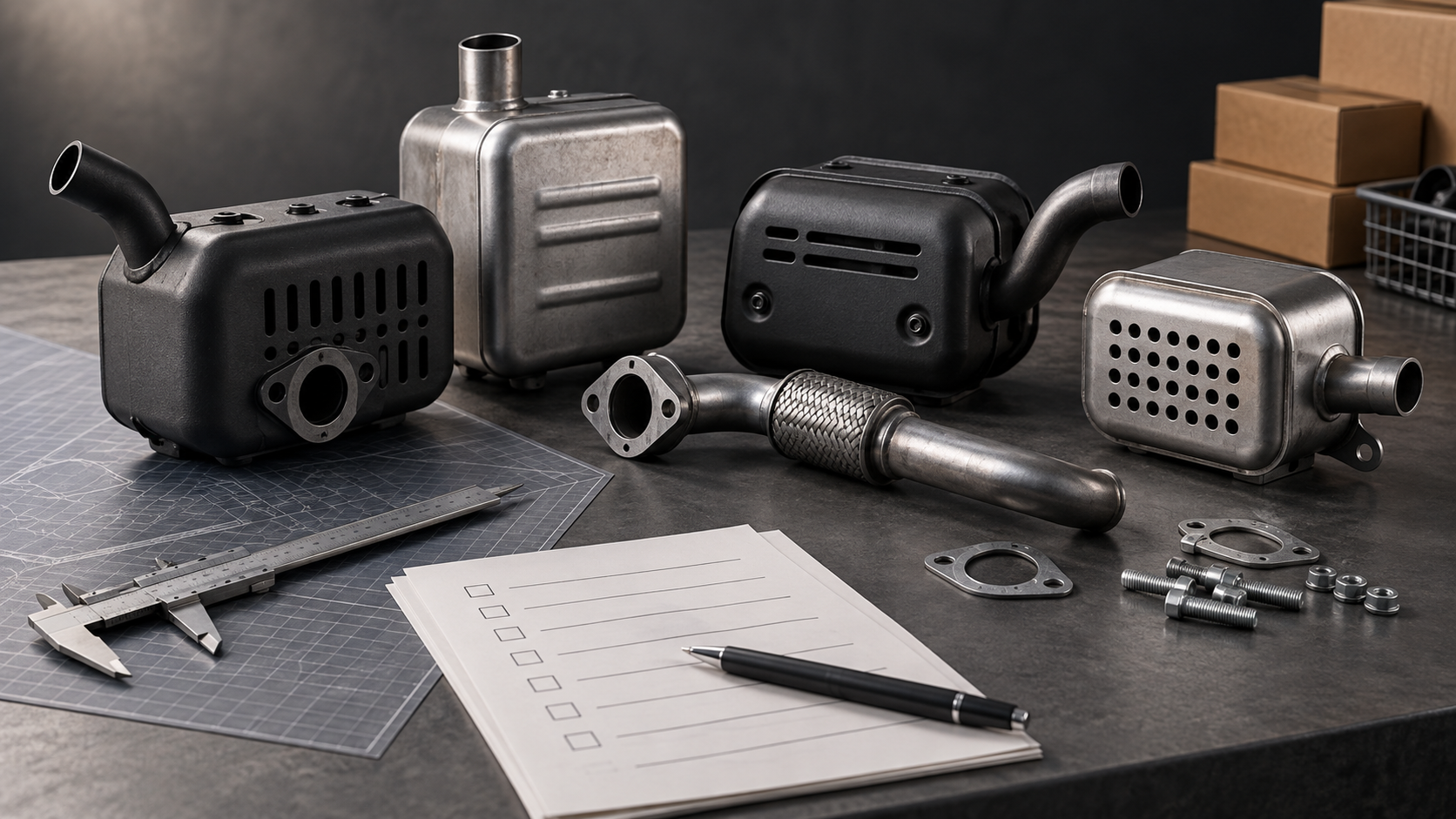
A muffler quote can look complete while the fitment record is still incomplete
Distributors and repair networks often receive a muffler request as an original reference, an equipment model, a photo, or a sample from a service counter. Each input can begin the search, but approving from one field alone can leave purchasing with the wrong application boundary, an unclear mounting arrangement, or a quoted unit that excludes related pieces the buyer expected.
For importers, wholesalers, aftermarket retailers, dealers, and repair networks, sourcing small engine mufflers wholesale is therefore a data-control task as much as a price exercise. The buyer needs a record that connects the request to a specific supplier candidate, shows what evidence supports the proposed fitment, and states exactly what the quoted line includes. That discipline helps prevent avoidable catalog corrections, reopened quotations, receiving questions, and return handling.
Set the approval boundary before comparing offers
Keep the buyer’s original request unchanged. If a supplier proposes a cross-reference or a wider application range, store that proposal in a separate field and attach its evidence. The requested item, the supplier candidate, and the final buyer approval are three different records. Combining them too early makes a tentative relationship look confirmed.
| Review layer | Buyer question | Evidence to retain |
|---|---|---|
| Source request | What was requested, and where did the information come from? | Original reference, equipment record, sample ID, or source image |
| Application | Which equipment or engine context is inside the requested scope? | Model and series details, supplier statement, and named exceptions |
| Physical interface | Which connection, mounting, orientation, and clearance details need review? | Candidate-specific views, named measurements, and units |
| Quoted unit | Is the offer for the muffler alone or a defined set? | Included and excluded components, unit of sale, and packaging request |
| Approval | What is confirmed, open, rejected, or awaiting buyer review? | Decision, reviewer, date, evidence source, and approved scope |
Use an eight-point wholesale muffler fitment checklist
1. Preserve the original reference exactly
Record the part number or other identifier exactly as received, including spaces, dashes, and suffixes. Note whether it came from a service record, prior invoice, catalog, equipment label, or physical sample. A normalized search value can be useful, but it belongs in a separate field so the source remains auditable.
2. Capture the equipment and engine context
Ask for the equipment type, equipment model, engine model or series, and any configuration information the buyer can verify. Do not assume that one reference found beside a model applies to every version in that family. If the application boundary is uncertain, mark it for buyer review rather than turning it into broad catalog wording.
3. Separate each supplier candidate from the request
Assign a candidate code to every offer from a replacement muffler supplier. Record whether the supplier describes it as a direct reference match, an application-based option, or a proposed alternative. That statement is evidence to review, not permission to overwrite the buyer’s source number.
4. Document the physical interface with named views
Request clear images of the inlet connection, outlet direction, mounting points, body profile, guards or covers where relevant, and any area the buyer treats as fitment-critical. If measurements are requested, define the start point, end point, unit, and evidence source. A general dimension without named points is difficult to compare and easy to reuse incorrectly.
5. Define the complete quoted scope
Some current product ranges may list a muffler, while other listings may describe a gasket, bolt, cover, cooling plate, or kit. Buyers should never infer that adjacent pieces are included. Ask the supplier to state the quoted unit, included components, excluded components, and whether each piece has its own reference or candidate code.
6. Control photos and sample identity
Use a consistent image sequence for every candidate: overall view, connection view, mounting view, outlet view, side profile, and any requested measurement views. Tie every filename to the RFQ row. If a physical sample is used, assign it an internal ID and keep its photos, measurements, supplier response, and approval under that same ID.
7. Record commercial and packaging requests separately
Fitment approval should not hide commercial assumptions. Put quantity, unit of sale, labeling request, packaging request, destination needs, and required documents in their own fields. Ask for confirmation instead of inserting a default. This keeps product evidence stable even when commercial terms change during negotiation.
8. Freeze the approved version for reorders
After approval, preserve the candidate code, reference relationship, application statement, image set, measurements, quoted scope, packaging instruction, reviewer, and date. If a later offer changes any of those fields, create a new review version. Do not silently update the record that supported an earlier purchase.
Build one controlled RFQ row per candidate
A practical worksheet for aftermarket replacement mufflers can include:
- buyer row ID, original reference, exact source wording, and evidence source;
- equipment type, equipment model, engine model or series, and application boundary;
- supplier candidate code and the supplier’s stated relationship to the request;
- inlet, outlet, mounting, orientation, body-profile, and clearance review fields;
- controlled measurements with named points, units, and image filenames;
- muffler-only or defined-set scope, plus included and excluded related pieces;
- quantity, unit of sale, labeling, packaging, destination, and document requests;
- exceptions, owner, review status, approver, approval date, and version number.
The same row-level discipline described in the aftermarket mower parts RFQ checklist applies here: send comparable fields to every candidate, keep open questions visible, and do not let a fast quotation replace a complete product record.
Understand where incomplete muffler data creates cost
Similar outlines can hide different interfaces
A familiar body shape is not enough to approve an item. Connection style, outlet direction, mounting pattern, profile, or surrounding clearance can change the usable application. When those details are absent, the hidden work appears later as technical follow-up, relabeling, listing corrections, branch questions, or returns.
Unclear component scope distorts price comparisons
One quote may cover a muffler only, while another may describe a set with related pieces. Comparing only the headline unit price makes unlike offers look equivalent. Normalize the quoted scope first, then compare price, evidence completeness, exception handling, packaging response, and documentation.
Unapproved cross-references spread across systems
A proposed relationship can move from an email into a purchase sheet, catalog, marketplace feed, and reorder file. Without a source and approval status, later users may treat it as established fact. Keep provenance and approval beside the relationship wherever it travels.
Loose image control weakens receiving checks
If a photo from one candidate is attached to another candidate’s row, purchasing and receiving cannot reconstruct the decision reliably. Consistent IDs, view names, and versioned evidence give the receiving team a usable comparison record without turning a thumbnail into the sole acceptance rule.
Compare suppliers on response quality, not only quotation speed
Send the same worksheet to every candidate. A useful response identifies the proposed item, answers the requested application and interface fields, provides candidate-specific images or documents, distinguishes confirmed points from open questions, and defines the commercial unit. A quick price with weak evidence simply transfers review work back to the buyer.
Begin with a focused set of references that has clear source data and meaningful demand. Close exceptions before widening the assortment. If samples are part of your normal approval process, decide in advance which fields will be checked, who will record the result, and which application boundary the decision covers. The outcome should be a reusable purchasing record rather than a one-time inbox judgment.
Where Yeahparts fits
Yeahparts presents aftermarket replacement parts for outdoor power equipment. Its current mufflers category includes application- and reference-based listings for mufflers and related exhaust items, while the broader engine parts category lets buyers review adjacent product scope. Buyers can submit a controlled reference list and ask which current listings or proposed alternatives fall within the available range. Fitment, included pieces, packaging, and commercial terms still need confirmation for each inquiry.
Buyer FAQ
Is an original reference enough to approve a small-engine muffler?
No. It is a strong starting point, but the buyer should also confirm equipment and engine context, the candidate’s physical interface, the supplier’s application statement, quoted scope, and any open exceptions.
Can buyers approve a replacement muffler from photographs?
Photographs can support the review when they are candidate-specific and paired with reference data, named measurements, and application evidence. A similar outline alone is not proof of interchangeability.
What should a wholesale muffler RFQ include?
Include the original reference and source, equipment and engine context, requested views and measurements, quoted-scope questions, quantity and unit, packaging request, destination needs, document requests, and an explicit exception field.
How should a supplier-proposed alternative be stored?
Keep it in a separate candidate field, attach the supplier’s evidence, list differences and open questions, and wait for authorized buyer approval before publishing or reusing the relationship.
How can distributors make muffler reorders more controlled?
Retain the approved candidate code, application statement, evidence set, quoted scope, packaging instruction, reviewer, date, and version. Treat a later change to any of those fields as a new review event.
Prepare a focused muffler list for review
Organize each source reference, equipment and engine context, candidate code, interface evidence, quoted scope, quantity, packaging request, and open question in one controlled file. Send that focused muffler list to Yeahparts for a current product-scope and quotation review.
Add comment