
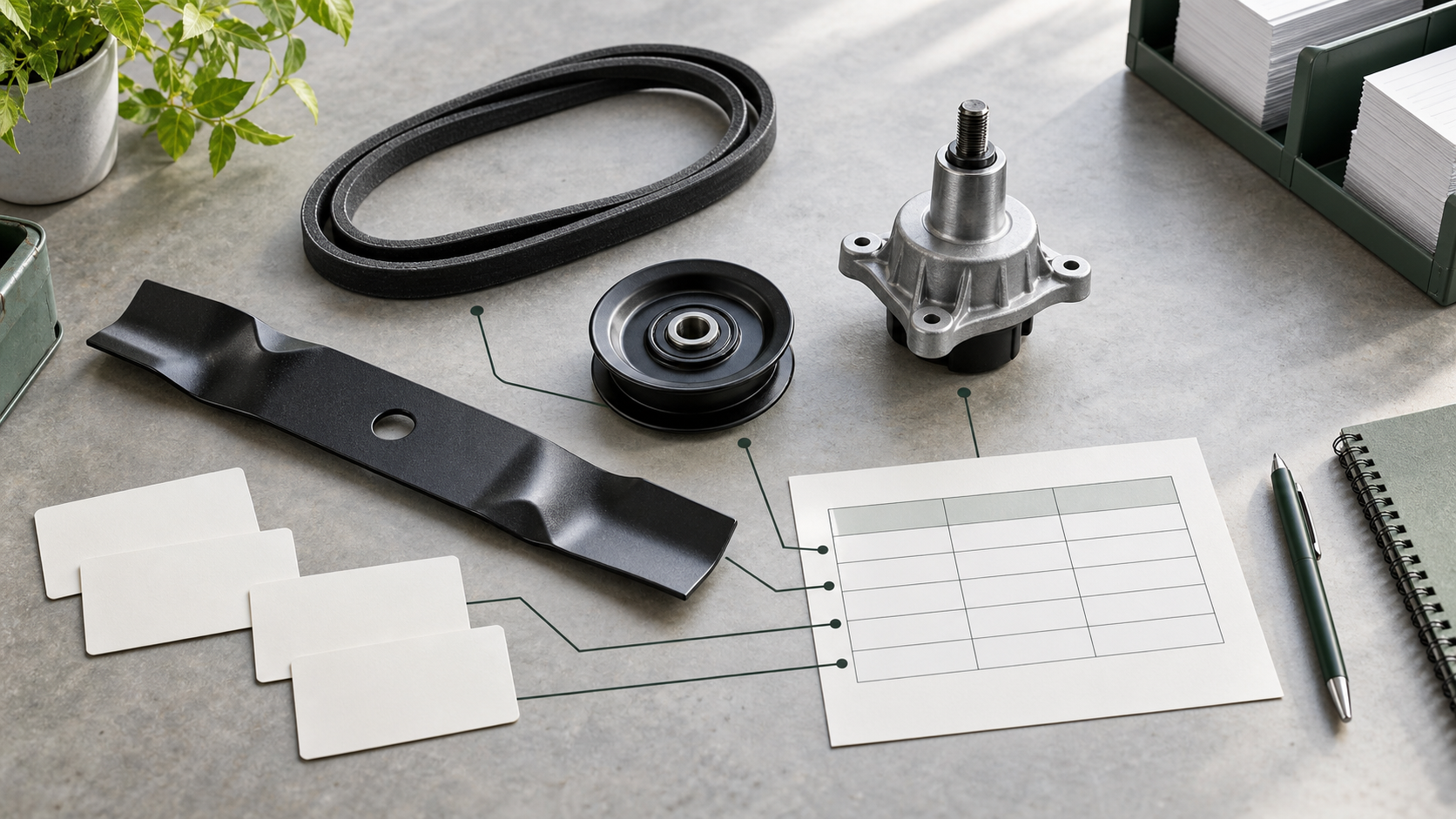
A cross-reference is a commercial decision, not just a spreadsheet cell
A distributor can lose margin long before a returned part reaches the receiving dock. Customer service may need to investigate the order, catalog teams may need to correct a listing, warehouse staff may handle the reverse movement, and purchasing may have to recheck other inventory built from the same mapping. When the source record is unclear, one mismatch can also create uncertainty across multiple SKUs.
Reliable mower parts cross reference data gives each proposed match a traceable basis, a review status, and a change history. It does not treat two part numbers as equivalent merely because they appear together in an email, an old file, or a supplier quote. For dealers, importers, wholesalers, and repair networks, that discipline supports cleaner catalog decisions and more focused supplier conversations.
Define what the cross-reference record is supposed to prove
A cross-reference record should answer a narrow question: why does the buyer believe one aftermarket replacement part is a candidate for a stated reference and application? It should not promise universal interchangeability. Equipment families can contain revisions, regional variants, engine differences, or assemblies that look similar while using different interfaces.
Separate three ideas in the data model:
- Requested reference: the number or description supplied by the customer, branch, or purchasing team.
- Proposed match: the candidate supplier item under review.
- Approved use: the exact applications or commercial scope your organization has accepted after reviewing its evidence.
Keeping these fields separate prevents a proposal from silently becoming an approved catalog claim.
Build a seven-field evidence record for every mapping
1. Preserve the original reference exactly
Store the incoming number as received, including meaningful prefixes, suffixes, spaces, or punctuation. Add a normalized search field separately if your system needs one. Never replace the original value during cleanup because the raw reference may help explain where a mismatch entered the workflow.
2. Identify the proposed item unambiguously
Record the supplier code, your internal SKU if assigned, a controlled description, unit of sale, and whether the item is a single component, set, or kit. If a revision or package change creates a new commercial item, do not hide it behind the old row. Clear item identity is the foundation of usable part number mapping.
3. Capture the application context
A bare number-to-number link is often too weak for catalog use. Add the equipment type and available model, engine, deck, series, or production context supplied with the request. Use only information your team can document. If application detail is missing, mark it as missing instead of inferring it from a similar-looking record.
4. Record the comparison attributes that matter
Define category-specific fields before reviewing candidates. A blade record may need a different comparison structure from a belt, cable, wheel, pulley, or spindle record. Dimensions, mounting interfaces, orientation, included components, and other identifying attributes should be captured only when relevant and supported by evidence. Do not assume that visual similarity proves fitment.
The live Yeahparts catalog separates broad lawn mower parts from product paths such as lawn mower blades. That category structure can help buyers organize review fields, but a category page does not validate a particular cross-reference.
5. Name the evidence source
For each mapping, retain the source type, source name, file or URL where appropriate, date reviewed, and reviewer. Evidence might include buyer-supplied application records, controlled supplier documentation, an approved sample review, or another source accepted by the buyer’s process. A note that says “confirmed” without a source is not a durable record.
6. Assign a status and confidence rule
Use visible workflow statuses rather than a single yes-or-no field. A practical set is: new, needs evidence, under review, approved for stated scope, rejected, and retired. Define who can move a row into an approved status and what minimum evidence is required. Confidence labels are useful only when the organization defines what they mean.
7. Control revisions
Store an effective date, last review date, change reason, and owner. When evidence changes, create a revision record rather than overwriting history. This matters when catalog feeds, branch systems, ecommerce listings, and purchasing files refresh on different schedules.
Use a decision table to prevent premature catalog release
| Record condition | Buyer action | Catalog treatment |
|---|---|---|
| Reference, application, and evidence are complete | Route through the defined approval review | Release only for the accepted scope |
| Candidate looks plausible but application detail is missing | Request the missing context | Hold; do not publish as a confirmed match |
| Sources conflict | Escalate for evidence comparison | Keep the mapping blocked |
| Supplier item or package has changed | Recheck affected attributes and records | Publish only after revision approval |
| Mapping is rejected or obsolete | Record the reason and replacement path | Retire it from active feeds |
This framework makes the exception visible. It also gives purchasing and catalog teams the same language when a quote includes an alternative item.
Understand where weak data creates cost
Returns are only the visible portion
A fitment-related return can trigger order research, freight handling, restocking review, catalog correction, customer communication, and a new sourcing cycle. The exact cost varies by business, so buyers should measure it with their own operational data rather than rely on a generic industry percentage.
One bad mapping can spread through multiple channels
If the same cross-reference feeds a website, printed catalog, branch counter, marketplace listing, and repair lookup, the exposure is wider than one order. A controlled source record and a clear downstream-owner list make correction faster.
Duplicate records hide disagreements
Teams often create parallel mappings when they cannot find or trust the master. Those files may use different descriptions, evidence, or approval rules. Consolidating them requires more than deduplication: reviewers must preserve conflicts until an owner resolves them.
Unclear units distort the commercial comparison
A match may describe the physical item correctly while the quote uses a different pack or kit basis. Cross-reference review and commercial review should therefore connect, but remain distinct. Record both the product identity and the quote unit.
Put cross-reference control into the sourcing workflow
Start before the RFQ. Export the requested references with one row ID per item, preserve the application information, and show which fields the supplier should complete. The existing aftermarket mower parts RFQ checklist explains the broader quote inputs; the cross-reference file should travel with that commercial brief as a controlled appendix.
- Prepare: remove obvious duplicates without deleting conflicting source records.
- Request: ask the supplier to place every candidate against the buyer’s row ID.
- Compare: review application context, identifying attributes, source evidence, unit, and exceptions.
- Approve: record the reviewer, scope, decision, and effective date.
- Publish: release only approved fields to the relevant catalog channels.
- Monitor: connect return reasons, customer questions, and supplier changes back to the source row.
Do not delete rejected candidates. Retaining the reason can prevent another team from repeating the same investigation.
Make the data usable across teams
A technically complete file can still fail if the fields do not travel cleanly. Use stable column names, controlled values, and a data dictionary that explains each field. Assign ownership for the mapping, product description, commercial unit, and customer-facing application statement. These responsibilities may belong to different people.
For larger assortments, review in batches by category and risk. Start with records that combine meaningful sales exposure, frequent questions, incomplete evidence, or recent changes. This prioritization is more useful than trying to clean every historical row at once.
Where Yeahparts fits
Yeahparts presents aftermarket replacement parts across lawn mower and outdoor equipment categories. Buyers evaluating a current sourcing list can organize requested references, application context, evidence fields, quantities, and units before supplier review. Yeahparts should be treated as a candidate supply source, not as proof that every buyer mapping is correct; each proposed match and commercial condition still requires confirmation for the stated inquiry.
Buyer FAQ
Is a cross-reference list enough to approve a replacement part?
No single list should automatically approve a match. Buyers should define the application scope, evidence requirements, category-specific comparison fields, reviewer, and decision status used by their organization.
Should the original part number be normalized?
A normalized search field can help matching, but retain the original reference exactly as received. This preserves traceability and helps reviewers spot meaningful suffixes or formatting differences.
How should conflicting cross-references be handled?
Keep both sources visible, block the mapping from approved use, and assign an owner to compare the application context and evidence. Record the final decision and why one source was accepted or rejected.
What data should be sent with a mower parts inquiry?
Include a row ID, original reference, equipment or application context, available identifying attributes, quantity and unit, evidence files, and the fields the supplier must return. Mark missing information explicitly.
How can return information improve the mapping file?
Use a controlled return-reason field and connect confirmed fitment findings to the source cross-reference row. A return should prompt review, not an automatic conclusion that every application linked to the item is wrong.
Turn your part-number list into a controlled review
Build one file that preserves the request, proposed match, evidence, status, owner, and revision history for every row. Send that focused mower parts list to Yeahparts for a current product-scope and quotation review.


Add comment