
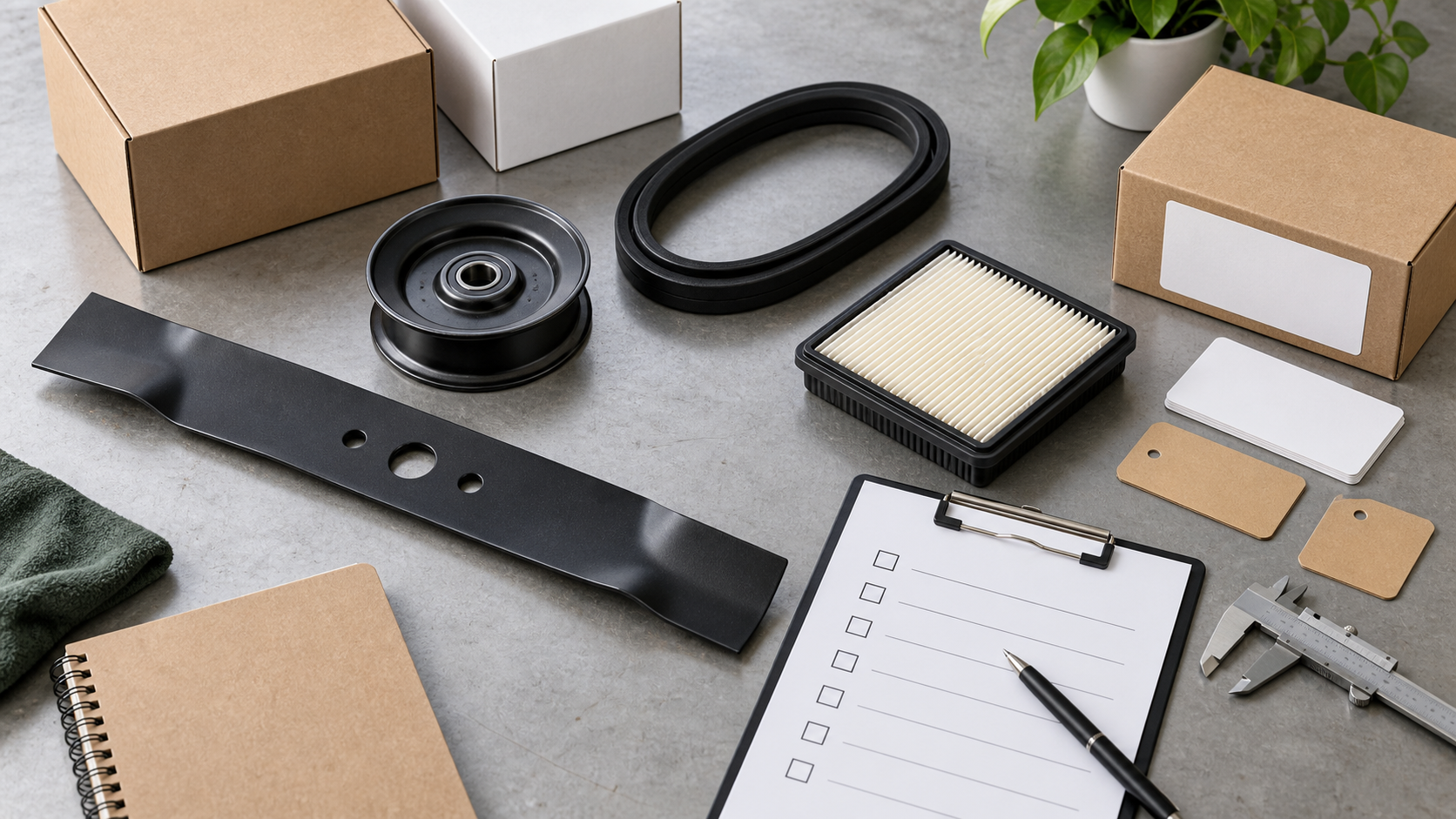
Private-label projects fail early when the brief is incomplete
A distributor may see private label as a packaging project, but the commercial pressure starts much earlier. Purchasing needs a comparable quote. Product teams need defensible fitment records. Brand teams need controlled artwork. Operations needs pack information that can move into receiving and the catalog. When those inputs arrive in separate email threads, a supplier can answer the wrong version of the request while every stakeholder believes the project is moving forward.
Successful private label mower parts sourcing begins with a buyer-owned brief. It should define what each item is, which evidence supports the match, what branding or packaging outcome is requested, who approves each stage, and which records must remain stable for reorders. It should also separate requirements from preferences. That distinction helps suppliers respond clearly without forcing buyers to invent assumptions about available options, minimums, pricing, or timing.
Start with the business case and channel
Before listing parts, state why the program exists. A dealer group launching a service-line assortment has a different need from an importer replacing inconsistent packaging across an established catalog. Define the sales channel, destination market, customer type, desired launch sequence, and internal owner. Retail-ready packaging may need different information from service-counter packaging, while a repair network may prioritize fast item identification. Use demand information your own business can defend rather than unsupported forecasts.
Build the brief in seven controlled sections
1. Define the product list one row at a time
Give every requested item a unique row ID. Include your internal SKU if one exists, a plain-language description, requested quantity and unit, whether the item is a piece, set, or kit, and the priority of the line. Keep exploratory items separate from order-ready items. A broad request for mower parts is not enough to support a useful commercial response.
Use live category pages to narrow the discussion. Yeahparts currently presents lawn mower aftermarket replacement parts and a dedicated lawn mower blades category. These pages can identify relevant product paths, but they do not confirm that every reference, private-label option, or configuration is available. Put exact requirements into the inquiry for current review.
2. Preserve fitment evidence
Private labeling does not reduce fitment risk. Record the original reference exactly as received, available equipment or engine information, and the source of any mapping. Attach photos or dimensions when they are part of your review process, then name and version those files so each stays tied to the correct row. Do not overwrite the requested reference when an alternative is proposed. Add the proposed mapping in a separate field and route it through approval.
3. Separate brand assets from product data
Create a controlled brand pack containing the approved logo file, color references, typography instructions, legal business name, contact details, and any market-specific copy supplied by your team. Identify the owner and revision date of every asset. If a barcode, importer detail, recycling instruction, warning, or language version is required, assign responsibility for providing and validating it instead of assuming the supplier will create it.
4. Describe the packaging outcome
State the requested package form, number of parts per pack, label location, required information fields, language, and how the item should be identified when received. Use a marked diagram or blank mockup where placement matters. Describe the outcome you need, then ask the supplier to confirm feasible materials, print methods, pack arrangements, commercial conditions, and current timing.
Precise custom packaging requirements are more useful than decorative concepts. A buyer can specify that the part number, internal SKU, item description, and brand mark must remain legible without claiming a particular process is available. Any supplier proposal should return as a documented option for review.
5. Establish approval gates
Define what must be approved before production or order release. Buyer-side gates may include product match, packaging specification, artwork proof, physical sample where required, commercial terms, and final purchase order. Name the approver for each gate and require approval to reference a file version and date. Do not treat a packaging mockup as proof of fitment or a product sample as approval of final artwork.
6. Make quote assumptions visible
For each line, request the quote unit, packaging basis, currency, applicable commercial terms, and a clear response for unavailable or alternative items. Ask the supplier to distinguish confirmed information from items requiring clarification. Never fill missing MOQ, price, availability, or delivery information with estimates from another project.
A structured aftermarket mower parts RFQ checklist can support the core commercial fields. The private-label brief adds brand assets, packaging outcomes, artwork control, and approval responsibilities to that sourcing foundation.
7. Design the reorder record before launch
Decide which approved records will become the master for replenishment. Retain the buyer SKU, supplier code, controlled description, fitment mapping, packaging specification, artwork version, pack basis, approval record, and revision date. Assign one owner for changes. The purchase order and email history are supporting evidence, not a substitute for a clean reorder master.
Use a readiness table before asking for a final quote
| Workstream | Buyer should provide | Decision before release |
|---|---|---|
| Commercial scope | Channel, market, line priority, quantity, and unit | Which rows are order-ready |
| Product identity | Reference, application data, evidence, and source | Approved mapping per row |
| Brand control | Logo files, colors, copy owner, and revision | Approved asset set |
| Packaging brief | Pack outcome, label fields, language, and mockup | Feasible option and approved proof |
| Quote control | Required response fields and comparison basis | Complete commercial review |
| Reorder record | SKU, codes, specifications, and versions | One controlled master |
Use statuses such as missing, supplier review, buyer review, approved, and held. A line should not move forward merely because its packaging looks finished. Product identity, commercial response, and artwork each need a visible status.
Understand the costs hidden in a weak brief
Artwork changes multiply across SKUs
A small correction consumes more attention when it must be found across many labels and files. A template with controlled fields and one approval owner reduces revision noise, even while production options are still being confirmed.
Ambiguous units distort comparisons
A price per piece cannot be compared with a price per kit or pack until the basis is clear. Packaging discussions add another unit. Normalize the product unit and packaging unit before comparing totals.
Unapproved fitment claims reach the catalog
If mappings and packaging copy are not linked to evidence, an uncertain reference can become customer-facing data. The cost is not only a return; it can create catalog cleanup, customer-service work, and slow-moving inventory.
Reorders restart the project
When artwork, mappings, and pack instructions are scattered, the next order repeats clarification. A versioned master turns the first launch into a reusable operating record instead of a one-time conversation.
Stage the program to protect the launch
Do not force every candidate item into the first release. Start with a controlled group of lines that have strong internal demand logic, usable fitment evidence, and complete brand inputs. Keep unclear references and unapproved packaging concepts in a separate development group. For each stage, define an entry rule, an approver, and an exit record. This keeps corrections from spreading across more items than necessary.
Where Yeahparts fits
Yeahparts presents aftermarket replacement parts for lawn and garden equipment and publicly notes custom branding on its website. Its support information also asks buyers to include customized requests such as packaging requirements with an order inquiry. Buyers should still submit the exact product list, fitment evidence, brand assets, and packaging brief, then request confirmation of the options and commercial terms currently available for those items. A general page does not approve a particular reference or private-label configuration.
Buyer FAQ
What should a distributor send first?
Send a controlled item list with row IDs, references, application evidence, quantities and units, target channel, packaging outcome, required label fields, and the owner of each approval. Separate order-ready lines from exploratory ones.
Should artwork be finished before product matching?
Not necessarily. Core brand assets can be prepared early, but item-specific copy should not be finalized until the product mapping and required package fields are approved. Keep brand development and fitment approval as related but separate workstreams.
How should buyers handle proposed cross-references?
Keep the original requested reference and the proposal in separate fields. Record the evidence, reviewer, decision, and revision date before using the mapping in an order, label, or catalog.
What packaging details belong in the brief?
Describe the requested package form, parts per pack, label location, required data fields, language, identification needs, and approval process. Ask the supplier to confirm feasible options rather than assuming materials, print methods, minimums, or timing.
What should the reorder master contain?
Retain the approved buyer SKU, supplier code, product description, mapping, package specification, artwork version, pack basis, approvals, and revision date. One owner should control later changes.
Prepare a supplier-ready private-label brief
Put the part list, fitment evidence, brand assets, packaging outcomes, approval gates, and reorder fields into one controlled package. Send that focused brief to Yeahparts for a current product-scope, packaging-option, and quotation review.


Add comment