
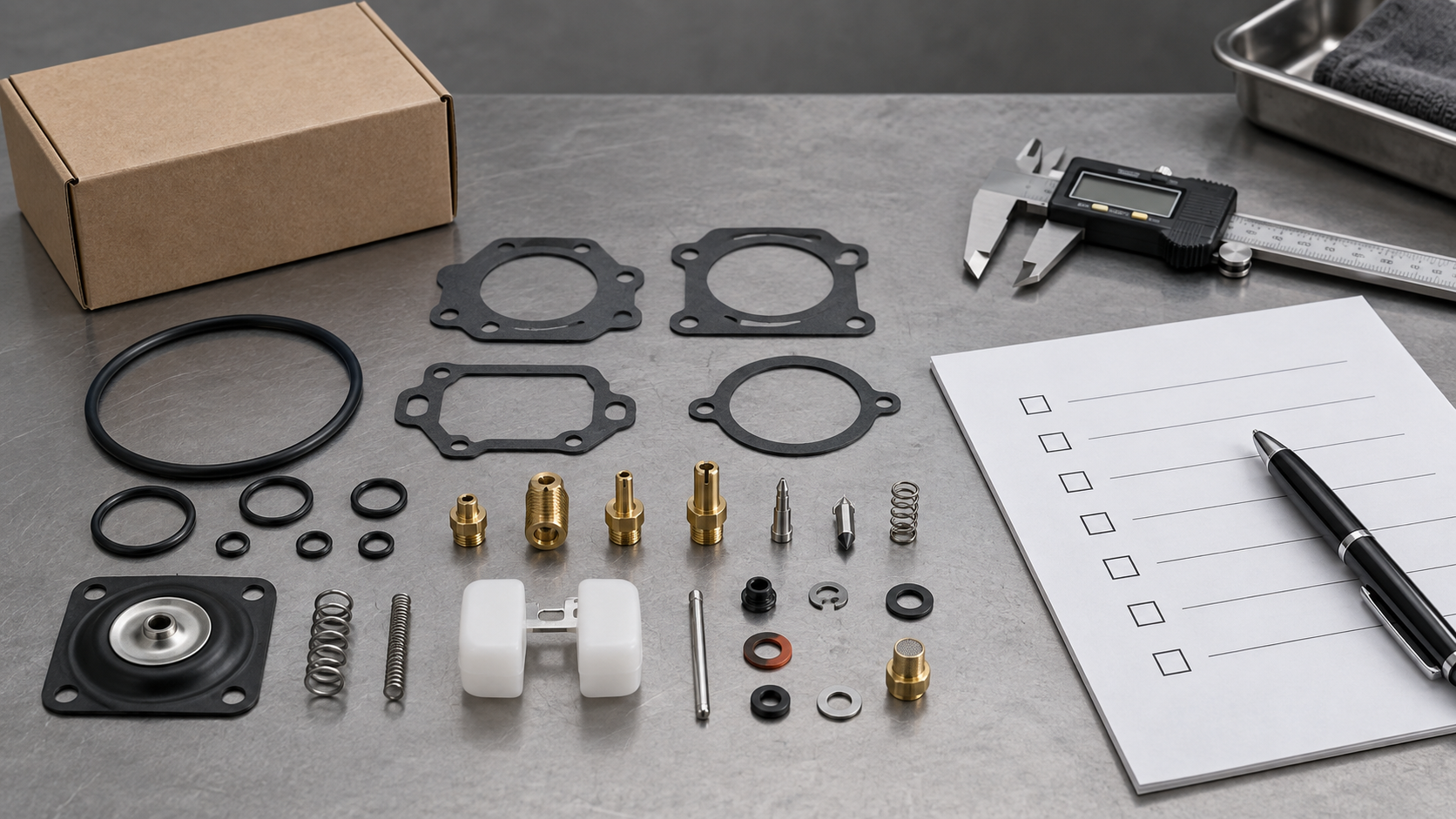
Why a familiar kit description can still create a costly mismatch
A distributor may receive a request for a carburetor repair kit that looks simple: one equipment model, one reference number, and a photo. Problems appear when the supplier finds several possible versions, the buyer’s catalog lacks an engine code, or the quoted kit contents do not match the repair job. A low-priced line is not a good buy if purchasing, catalog, receiving, and customer-service teams must keep resolving the same identity gap.
For buyers sourcing carburetor repair kits wholesale, the safest starting point is a fitment conversation organized around evidence. A repair kit is a set of related components, so the buyer must identify both the carburetor application and the expected contents. These eight questions help dealers, distributors, importers, wholesalers, aftermarket retailers, and repair networks prepare a cleaner RFQ and compare supplier replies on the same basis.
The eight-question fitment framework
Use one row per requested kit and require each supplier to answer the same fields. Keep unknowns visible. An unanswered question is a manageable review item; an assumption hidden inside a product description is harder to control.
1. What reference number starts the match?
Record the number exactly as the customer, catalog, or internal system provided it. Keep the source beside it and distinguish an equipment-maker reference from your SKU and the supplier’s item code. If several numbers appear as alternatives, ask whether they are supersessions, cross-references, or separate applications.
2. Which engine, machine, and application version is involved?
A machine family name alone may not identify the carburetor version. Ask for the engine model, machine type, and any available type, specification, series, or date information used by the buyer’s records. This matters when an engine family appears across mowers, generators, pumps, or other outdoor power equipment.
3. Is the request for a complete carburetor, a repair kit, or selected service parts?
These are different purchasing lines. A customer asking for a “carb kit” may mean a complete carburetor, a gasket set, a diaphragm set, or selected small engine carburetor parts. Translate informal wording into a precise item type. If a supplier offers several options, keep each on its own row so price and contents stay traceable.
4. What components must the kit contain?
Ask for a component list and compare it with the buyer’s required service scope. Do not infer contents from a generic kit name or one image. If a gasket, diaphragm, needle, seat, primer component, or other item matters, name it in the request and ask whether it is included.
5. What evidence can separate similar versions?
Request evidence appropriate to the part under review. This may include views of mounting points, linkage arrangement, fuel connections, primer location, gasket outline, diaphragm shape, or other distinguishing features. Dimensions can help, but one measurement is not complete proof of fitment. Label every buyer-supplied photo and measurement by source and revision.
6. Which fitment statements are confirmed, conditional, or still open?
Make confidence visible. A supplier can mark a line as matched to the supplied reference, matched only if a stated condition is true, or unresolved pending more data. Conditional matches should name the missing evidence, such as a carburetor marking, engine type, or comparison photo.
7. How will the item be identified in the quote, sample, and reorder?
Ask the carburetor kit supplier to carry a stable item code and description through each stage. The quote row, sample record, packaging identification, purchase order, and reorder file should refer to the same approved line. Record any later cross-reference or content change as a revision.
8. What commercial fields are needed to compare the offer?
After product identity is clear, request the fields your process uses: quote unit, currency, pack basis, packaging description, and the order rules provided for this inquiry. Do not insert assumed minimums, delivery promises, or stock positions when a supplier has not documented them.
| Review block | Buyer input | Supplier response | Risk controlled |
|---|---|---|---|
| Reference | Source number and internal SKU | Supplier code and mapping note | Wrong cross-reference |
| Application | Engine, machine, and version data | Fitment basis and conditions | Family-level overmatching |
| Kit scope | Requested item type and required contents | Quoted contents and alternatives | Incomparable kits |
| Evidence | Photos, markings, dimensions, source | Matched features and open questions | Look-alike selection |
| Control | Row ID, owner, approval status | Stable code and revision | Reorder drift |
Turn the questions into a quote-ready RFQ
The framework works best as a controlled worksheet rather than a long email chain. Start with the highest-priority references and build one row for each distinct item.
- Normalize the source list. Preserve the original reference, add a unique row ID, and separate complete carburetors from repair kits and individual parts.
- Add application evidence. Attach only relevant, buyer-controlled photos or records and label their source.
- Define required fields. Make the identifiers and kit contents needed for approval explicit.
- Request structured replies. Ask suppliers to complete the same columns, leave unknowns visible, and reference row IDs in questions.
- Separate quote from approval. A quoted item remains under review until the responsible team accepts its fitment evidence and kit scope.
- Freeze the approved record. Retain the supplier code, confirmed description, revision, and evidence for reorders.
This product-level sheet can sit inside a broader aftermarket replacement parts RFQ checklist. The general RFQ controls quantities, commercial terms, and response format; the carburetor worksheet controls fitment and kit identity.
Where incomplete fitment data creates avoidable cost
Clarification time accumulates
When a buyer sends only a broad model or unlabeled photo, the supplier must ask questions. Purchasing relays them to product staff or customers, and every answer can create another version of the request. A structured first submission keeps open questions visible and tied to a row.
Different kit scopes make prices look comparable
Two quotes can use the same repair-kit label while including different components. Comparing only the line price hides the difference. Normalize contents and pack basis first, then evaluate the options using the buyer’s service and resale needs.
Catalog errors survive into reorders
A weak match may be copied from a quote into an ERP record, web listing, or customer price file. If a later clarification does not reach the approved record, the same question returns at reorder. Revision control is therefore part of fitment control.
Compare responses on decision readiness
| Question | Decision-ready response | Needs clarification |
|---|---|---|
| Reference mapping | Each row maps to a supplier code or stated gap | References are merged or omitted |
| Application basis | Identifiers and conditions are visible | Only a broad model family is repeated |
| Kit contents | Included components are listed | “Repair kit” stands alone |
| Evidence | Matched features and open questions are separated | Confidence is implied but unexplained |
| Commercial basis | Quote unit and pack information are explicit | Prices use unclear units |
| Reorder control | Stable code, description, and revision are provided | The line cannot be traced forward |
Weight the rows according to commercial importance. A high-demand replacement may justify more up-front verification, while an exploratory line can remain on hold until evidence and demand support a sample or order decision.
Build the assortment from verified demand
Do not start by filling every catalog slot. Start with customer requests, known service demand, planned equipment coverage, and clear gaps in the current range. The carburetors and repair kits category shows the relevant Yeahparts product path, while the carburetor wholesale page provides a focused B2B inquiry route. Treat current live pages as a scope check, not proof that every requested reference or kit configuration is available.
Where Yeahparts fits
Yeahparts lists carburetors and repair kits among its aftermarket replacement parts categories and asks buyers to provide a reference number or model fit for compatibility review. A focused worksheet containing priority references, application data, required kit contents, and visible open questions gives the inquiry a practical starting point. Final fitment and commercial decisions should remain tied to the documented response and the buyer’s approval process.
Buyer FAQ
Is a reference number enough to approve a repair kit?
It is a strong starting point, but approval may require application details, kit contents, visual evidence, or other identifiers. Keep the source visible and ask what supports the supplier’s match.
Should complete carburetors and repair kits share an RFQ row?
No. Put each distinct option on its own row so scope, contents, price, pack basis, and approval status remain comparable.
How should buyers handle uncertain fitment?
Mark the line as conditional or unresolved, record the missing information, and keep it out of the approved reorder set until the responsible team reviews the evidence.
What photos are most useful?
Use clear, labeled views showing identifiers or features relevant to the open question. A single general photo rarely proves the full application.
What should be retained after approval?
Keep the original request row, supplier code, confirmed description, kit contents, supporting evidence, revision, and approval status in a controlled record.
Prepare a cleaner carburetor kit inquiry
Consolidate priority references, engine and machine data, required kit contents, comparison evidence, and unresolved questions into one worksheet. Send the focused list to Yeahparts for a current product-scope and quotation review.
Add comment