
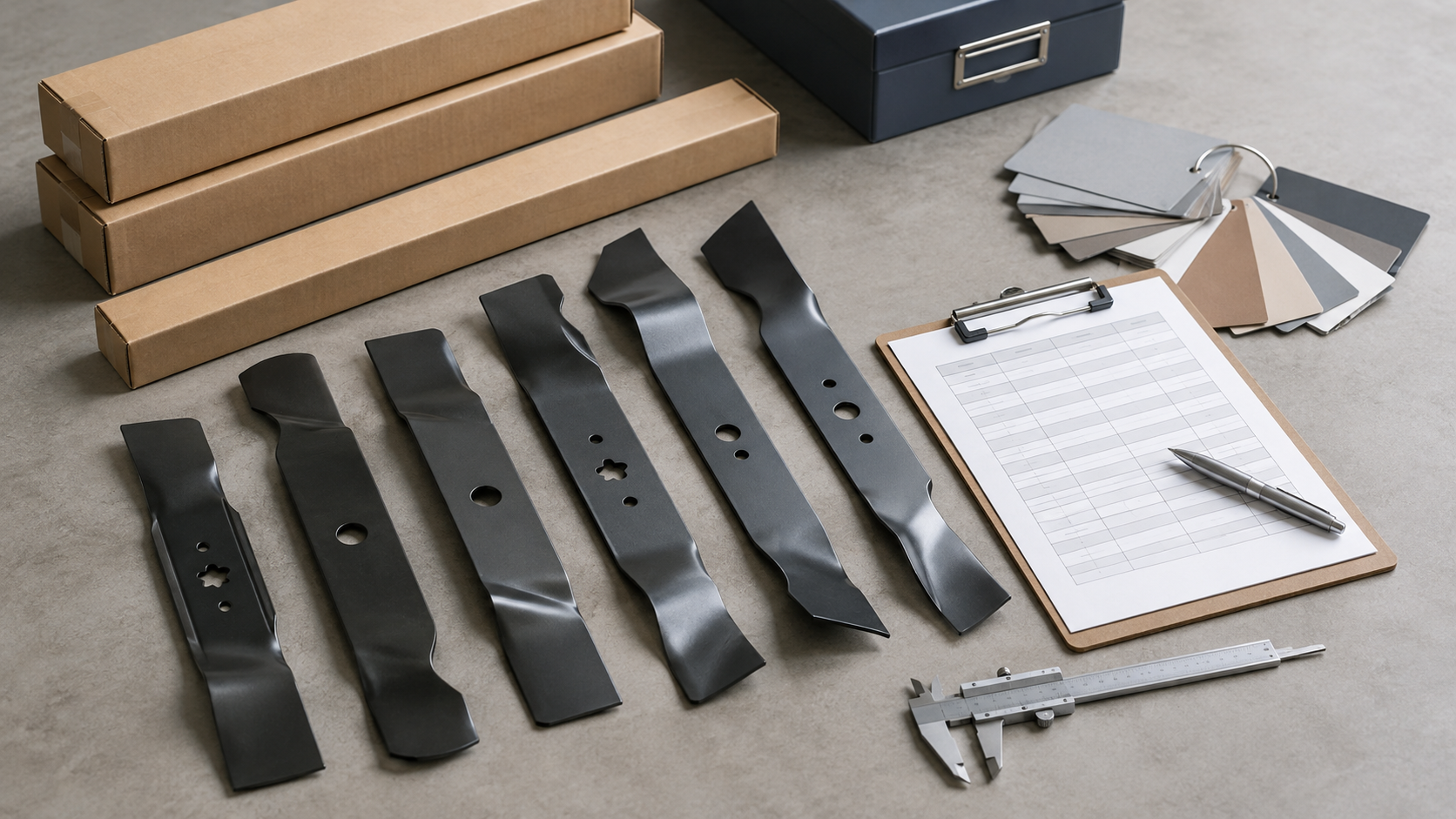
Why blade quote problems usually begin with the data
A distributor can ask three suppliers for the same blade range and receive three quotes that look impossible to compare. One file may lead with cross-reference numbers, another with dimensions, and a third with application notes. Similar descriptions may represent different mounting patterns, profiles, or pack arrangements. When seasonal demand is approaching, every clarification cycle slows the buying decision and increases the chance that an incorrect line enters the catalog.
That is why sourcing wholesale lawn mower blades should begin with a controlled buyer data set, not a price column. Give each prospective supplier the same inputs, require the same outputs, and preserve a traceable decision for every approved SKU. This checklist helps dealers, importers, wholesalers, aftermarket retailers, and repair networks turn a mixed blade list into a quote-ready package.
The six-part buyer data checklist
The most useful sheet is detailed enough to expose gaps but simple enough for purchasing, product, and catalog teams to maintain. Adapt these fields to the way your business identifies aftermarket replacement parts.
1. Internal demand and assortment role
Start with your own SKU, product-family label, channel, and intended assortment role. Mark whether a line supports an established seller, fills a known catalog gap, or is being evaluated as an alternative source. Include demand history only when you have reliable internal data. This separates must-cover references from speculative additions.
2. Cross-reference chain
Record every reference supplied by your customer, catalog, or internal system, but keep its source visible. A lawn mower blade cross-reference data field should not become an untraceable string copied between spreadsheets. Use separate columns for the buyer reference, supplier reference, prior internal SKU, and application note. Ask the supplier to flag uncertain mappings instead of choosing the nearest-looking item.
3. Physical identification fields
Request the dimensions and mounting details needed to distinguish the blade, using consistent units and field names. Depending on the reference, that may include overall length, width, center opening, secondary-hole arrangement, profile, offset, lift style, and orientation notes. Do not treat a single dimension as proof of fitment. A useful response shows what comes from the supplier record and what still needs confirmation.
4. Application and blade function
Keep equipment application data separate from physical fields. Ask for the supported deck or machine context when available, plus the blade function in the supplier catalog. Do not merge standard, high-lift, low-lift, or mulching descriptions into one line merely because the main dimensions look alike. Buyers need to know whether references are substitutes, application-specific options, or separate entries.
5. Commercial and packaging data
A usable quote covers more than unit price. Request the quote unit, currency, packing unit, units per carton, carton identification method, label options, and any minimum order or mixed-order rules the supplier actually offers for the inquiry. Packaging matters because a catalog-fit line can still create receiving or picking work if its pack configuration does not match the distributor’s process.
6. Evidence, revision, and ownership
Add a status for sample required, buyer approved, supplier clarification, or hold. Store the latest drawing, photo, sample note, or catalog source beside the line, and give the record a revision date and owner. This prevents an older attachment from overriding a later clarification and makes reorders easier.
| Data block | What the buyer should capture | Risk it controls |
|---|---|---|
| Identity | Internal SKU, buyer reference, supplier reference | Duplicate or misrouted records |
| Geometry | Dimensions, openings, profile, orientation notes | Look-alike fitment errors |
| Application | Machine or deck context and blade function | False substitution |
| Commercial | Quote unit, pack unit, carton data, order rules | Uncomparable handling assumptions |
| Control | Evidence source, status, owner, revision date | Approval based on stale information |
Turn the spreadsheet into a quote-ready package
A clean RFQ is not the longest file. It makes unresolved questions obvious and keeps the mower blade supplier focused on the references that matter.
- Normalize the source list. Put one requested item on each row, use one unit system per field, and separate notes from confirmed values.
- Group priorities. Divide core coverage, secondary coverage, and evaluation-only lines so the supplier can address the commercial center first.
- Attach evidence selectively. Include buyer-controlled photos, drawings, or sample references that help identify a line.
- Define the reply format. Ask every supplier to complete the same columns and mark unknown fields rather than changing the sheet.
- Set clarification rules. Require questions to reference the row ID and keep answers in the decision record.
- Separate quote review from approval. A quoted line is not automatically catalog-approved. Keep validation status visible until the responsible team accepts it.
This format complements a broader aftermarket mower parts RFQ checklist. The general RFQ controls the inquiry; the blade data sheet controls the product-level comparison.
Where incomplete data creates avoidable cost
Wrong matches travel downstream
An unclear reference can survive the quote, purchase order, receiving process, and product upload before a customer exposes the mismatch. Staff may then need to investigate records, correct listings, handle returns, and explain inconsistent availability. A slower identification decision can cost less than a fast decision built on weak evidence.
Duplicate SKUs hide inside different descriptions
Two suppliers may describe the same commercial reference differently, while two nearly identical descriptions may cover different mounting details. Without a structured cross-reference chain, a buyer can add duplicate stock or collapse distinct items into one record. Both outcomes reduce inventory clarity.
Pack differences distort the comparison
A lower quoted unit price does not reveal the receiving or handling impact of the pack configuration. Compare the actual quote unit and packaging information, then evaluate how each option fits your warehouse and customer-order flow. Label missing fields as missing rather than filling them with an assumed norm.
How to compare supplier answers without relying on price alone
Use a small framework after all responses are normalized. Its purpose is to show which quote is decision-ready and which still carries unidentified work.
| Review question | Strong response | Needs clarification |
|---|---|---|
| Reference mapping | Each row maps to a supplier line or a stated gap | Rows are merged, renamed, or omitted without explanation |
| Product data | Identification fields use consistent units and sources | Only a description or one dimension is returned |
| Application notes | Compatibility context and uncertainty are separated | Broad fitment language lacks a traceable basis |
| Commercial terms | Quote unit and packing basis are explicit | Pricing cannot be reconciled with pack data |
| Change control | Questions, revisions, and approval status are visible | Different answers circulate without an owner or date |
Weight the fields according to the line’s commercial role. For established demand, completeness and reorder clarity may carry more weight. For a new range, resolving identification gaps before a sample decision may matter more.
Build the range around decisions, not catalog volume
A large blade file can look impressive while leaving the buyer uncertain about what to stock. Start with references connected to observable demand, active requests, or a deliberate coverage plan. The broader lawn mower parts range helps place blades within a mixed-category program, while the dedicated lawn mower blade category provides the relevant product-page path.
Keep seasonal timing in the workflow, but do not let urgency erase approval gates. Buyers can request early feedback on high-priority references, hold uncertain rows, and release confirmed lines in stages.
Where Yeahparts fits
Yeahparts presents lawn mower blades and other aftermarket replacement parts through dedicated category pages. For a B2B inquiry, the useful starting point is a focused list with buyer references, identification data, priorities, and open questions. Yeahparts can review that list against its current product scope and respond to the specific inquiry. Fitment and commercial details should remain tied to the documented quote and approval process.
Buyer FAQ
What is the minimum data needed to request a mower blade quote?
Begin with a stable row ID, buyer reference, application context, available dimensions or mounting information, requested quantity basis, and evidence source. Mark anything uncertain so the supplier can identify what needs further review.
Is a cross-reference number enough to approve an aftermarket blade?
No. It is an identification lead, not the full approval record. Compare relevant physical fields, application context, supplier documentation, and any buyer-required sample review.
How should buyers compare quotes with different pack units?
Normalize responses to the same decision basis while retaining each supplier’s original quote unit and pack details. Then assess receiving, storage, picking, and customer-order impact using your own operating data.
Should every quoted blade be added to the catalog?
No. Separate established-demand lines, planned coverage gaps, and evaluation-only references. A quote can support sourcing without justifying inventory or a new public SKU.
How can a buyer reduce clarification cycles?
Use one structured sheet, consistent field names and units, relevant evidence, row IDs, and visible unknowns. Keep revisions in the same controlled record.
Prepare a cleaner blade RFQ
Consolidate your priority references, known identification fields, pack requirements, and unresolved fitment questions into one file. Send that focused list to Yeahparts for a product-scope and quotation review.

Add comment